Views: 0 Author: Site Editor Publish Time: 2026-07-22 Origin: Site
Market demand for complex, high-margin food products like texturized plant proteins, fortified snacks, and premium pet foods continues to surge. These advanced formulations quickly expose the limitations of legacy single-screw extrusion systems. Food manufacturers face a strict operational challenge: they must balance high throughput, absolute product consistency, and extreme ingredient flexibility without escalating energy costs or suffering excessive downtime. Relying on outdated equipment often leads to ingredient waste, inconsistent textures, and frequent maintenance bottlenecks.
Modern production facilities require equipment capable of handling diverse moisture levels, high fat contents, and complex thermal profiles. The twin screw extruder food processing system serves as the industry standard for advanced manufacturing. By integrating precise thermodynamic control with positive displacement pumping, these systems allow operators to execute multiple distinct product runs on a single line. This article evaluates the mechanics, primary applications, and technical specifications of these systems to guide effective procurement and operational decisions.

Unmatched Formulation Flexibility: Twin screw systems handle a wider range of moisture levels, fat contents, and particle sizes compared to single-screw alternatives, enabling multi-product manufacturing on a single line.
Superior Process Control: Co-rotating, fully intermeshing screws provide precise control over shear, temperature, and pressure, critical for complex texturization (like high-moisture extrusion for meat analogues).
Operational Efficiency via Self-Wiping: The intermeshing design prevents material buildup, reducing cross-contamination risks and significantly decreasing downtime between product changeovers.
High Initial CapEx, Favorable Long-Term ROI: While upfront costs are higher, the investment is typically justified by higher yield, reduced waste, and the ability to manufacture premium-tier products.
Table of Contents
Extrusion systems generally utilize either co-rotating or counter-rotating screw configurations. Counter-rotating extruders feature screws turning in opposite directions, often used for low-shear pumping of highly viscous materials in plastics or heavy industrial applications. However, co-rotating, fully intermeshing extruders dominate food manufacturing. In a co-rotating setup, both screws turn in the same direction. This design creates a continuous figure-eight flow pattern, ensuring superior dispersive and distributive mixing. The intermeshing profile actively wipes the flights of the opposing screw, preventing material stagnation and ensuring uniform shear application across the entire product matrix. When running sticky doughs or high-protein recipes, this self-wiping action prevents localized burning and material degradation.
Modern systems rely on segmented screws and modular barrel sections. Instead of a single solid screw shaft, individual screw elements slide onto a splined shaft. This modularity allows process engineers to configure the exact shear and pressure profile required for a specific recipe. Conveying elements utilize positive displacement to move material forward efficiently. Kneading blocks apply intense mechanical energy for dispersive and distributive mixing, breaking down particles and blending liquids into dry powders. Reverse-flight elements create intentional flow restrictions, building pressure and precisely controlling the residence time within specific barrel zones. Plant operators frequently swap these elements during scheduled maintenance to transition a line from a low-shear snack product to a high-shear texturized protein.
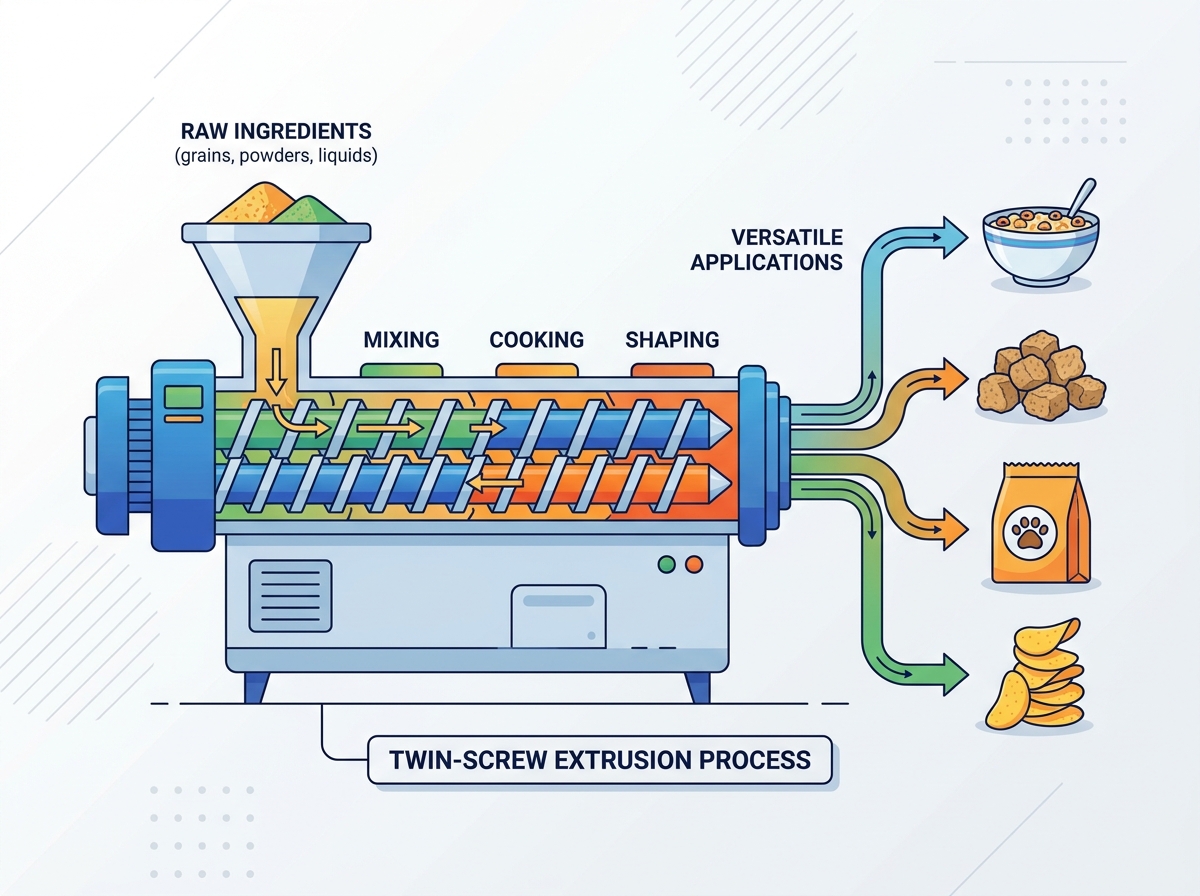
Food extrusion relies on the precise interaction between mechanical energy and thermal energy. The mechanical shear generated by the rotating screws physically tears and aligns polymer chains, such as starches and proteins. Simultaneously, thermal energy applied through barrel heating or cooling jackets controls the melt temperature. Specific Mechanical Energy (SME) measures the amount of mechanical work transferred from the motor into the food matrix. Monitoring and controlling SME dictates product consistency; maintaining a consistent SME ensures that every batch achieves the exact same expansion ratio, density, and textural profile. Operators adjust screw speed, feed rate, and water injection to dial in the exact SME required for the target product.
Single-screw systems rely heavily on friction between the material and the barrel wall to convey product forward. If a recipe contains high oil or moisture, friction drops, causing the material to slip and throughput to plummet. A twin screw extruder operates on the principle of positive displacement. The intermeshing flights create enclosed chambers that physically push the material toward the die. This mechanism guarantees consistent throughput regardless of ingredient viscosity, lipid content, or fluctuating die pressure. You can push high-fat pet food formulations or wet meat slurries without losing forward momentum.

Extrusion technology drives the plant-based protein sector. Dry Texturized Vegetable Protein (TVP) involves processing defatted soy, pea, or wheat flours at 20-30% moisture. The high heat and shear melt the proteins, which then expand rapidly upon exiting the die, creating porous, shelf-stable chunks used as meat extenders. High-Moisture Extrusion (HME) operates differently. Processing ingredients at moisture levels above 50%, the system melts the proteins and forces them through a long, specialized cooling die. This cooling process aligns the protein molecules into distinct, laminar fibers, replicating the exact texture of whole-muscle animal meat. The cooling die prevents the water from flashing into steam, maintaining the dense, wet structure of the final product.
Parameter | TVP (Texturized Vegetable Protein) | HME (High-Moisture Extrusion) |
|---|---|---|
Moisture Content | 20% - 30% | 50% - 70% |
Die Type | Standard expansion die | Long cooling die |
Final Texture | Porous, spongy, requires hydration | Dense, fibrous, whole-muscle like |
Shelf Life | Long (shelf-stable) | Short (requires refrigeration/freezing) |
Producing crisp snacks and cereals requires exact control over the pressure drop at the die plate. The extruder cooks a matrix of corn, wheat, or oat flour under high pressure and temperature. As the superheated moisture hits atmospheric pressure at the die exit, it flashes into steam, expanding the starch matrix instantly. Operators can process complex multi-grain formulations and incorporate high-sugar, high-fiber, or high-fat ingredients without losing the desired bulk density or crunch. Adjusting the cutter speed at the die face determines the final shape and length of the expanded collet.

Center-filled pillows and tubes require synchronized equipment integration. The extruder cooks and expands the outer cereal shell. Simultaneously, a secondary filling pump injects creams, fruit pastes, or savory cheeses directly into the hollow center of the expanding shell at the die head. The continuous rope is then crimped and cut, sealing the moisture-rich filling inside the crisp exterior. Managing the moisture migration between the wet filling and the dry shell dictates the shelf life and textural integrity of the final product.
Pet food and aquafeed manufacturers utilize twin screw systems to process highly nutritious, complex recipes. These extruders easily handle fresh-meat inclusions reaching 40-50% and high lipid contents. For aquafeed, the precise control of SME and barrel temperatures allows operators to manipulate the expansion of the pellet, creating feeds that either float, sink slowly, or sink rapidly depending on the target aquatic species. Vacuum coating systems downstream often add additional fats and palatants to the extruded kibble.
Producing baby foods, nutritional powders, and modified starches requires gentle processing. The short residence time within the extruder barrel, combined with exact temperature control, prevents the thermal degradation of heat-sensitive vitamins, minerals, and active pharmaceutical ingredients (APIs). The continuous process ensures a highly homogeneous distribution of micronutrients throughout the final powder. Manufacturers often use low-shear screw profiles to prevent excessive starch degradation when producing infant formulas.
In the confectionery space, extrusion replaces traditional batch cooking. It enables continuous starch-gelling for licorice and fruit snacks. Furthermore, the technology is utilized for flavor encapsulation, where volatile flavor compounds are trapped inside a protective carbohydrate matrix, ensuring a long shelf life and controlled release upon consumption. The closed barrel environment prevents the loss of expensive volatile aromatics during the cooking phase.

Single-screw systems operate within narrow ingredient parameters. They typically fail when fat limits exceed 3% or when moisture falls outside the 10-20% range. Twin screw systems offer a massive operational window. They effortlessly process recipes with fat limits exceeding 20% and can handle moisture spectrums ranging from a dry 10% up to a liquid-heavy 90%. This flexibility allows a single production facility to run dry kibble in the morning and high-moisture meat analogues in the afternoon.
Single-screw extruders rely on simple laminar flow, which provides limited mixing capability. Twin-screw configurations deliver intense distributive mixing (folding and recombining the melt) and dispersive mixing (breaking down hard particles and droplets). This ensures a perfectly homogeneous dough, necessary for consistent flavor and texture. Poor mixing leads to unhydrated starch pockets and weak pellet structures, which twin screw systems actively prevent.
When processing slippery, high-fat, or high-viscosity recipes, single-screw machines often experience surging—a phenomenon where output flow becomes erratic and pulsates. The positive displacement action of intermeshing twin screws completely eliminates surging, ensuring a steady, predictable flow of material through the die plate. Consistent flow prevents die blockages and ensures uniform pellet sizing at the cutter head.
The self-wiping profile of co-rotating twin screws provides a significant operational advantage. Because the flights of one screw continuously wipe the root of the other, material cannot bake onto the shafts. This self-cleaning action drastically reduces manual cleaning times and allows facilities to execute rapid transitions between distinct product runs without severe cross-contamination risks. Operators simply run a purge material through the barrel before switching recipes.
Feature | Single-Screw Extruder | Twin-Screw Extruder |
|---|---|---|
Conveying Mechanism | Friction-dependent | Positive displacement |
Moisture Range | 10% - 20% | 10% - 90% |
Fat Handling Capacity | Low (<3%) | High (Up to 20%+) |
Mixing Capability | Basic laminar flow | High dispersive & distributive |
Self-Cleaning | Poor (requires manual teardown) | Excellent (self-wiping profile) |
Selecting the correct L/D ratio dictates the available processing time and space within the barrel. Ratios typically range from 15:1 for simple snacks to 40:1 for complex protein texturization. A longer L/D ratio provides the necessary zones for mixing, cooking, venting steam, and vacuum degassing. Modular barrel designs future-proof production lines, allowing engineers to add or remove barrel sections when swapping between simple carbohydrate snacks and complex protein recipes. You must match the L/D ratio to the specific thermal and mechanical requirements of your primary product.
Modern extrusion leans heavily toward high-torque density machines. High torque density allows for increased volumetric capacity and higher mechanical energy input without requiring a larger screw diameter. Evaluate the energy efficiency of the drive train carefully. Direct drive systems and advanced gearbox setups minimize mechanical losses, ensuring that motor power translates directly into usable shear energy. A robust gearbox prevents catastrophic failures when processing dense, high-viscosity doughs.
An extruder cannot function in isolation. The system relies entirely on accurate upstream dosing. Loss-in-weight feeders must deliver dry ingredients with pinpoint accuracy. Pre-conditioners hydrate and pre-heat raw materials, increasing overall extruder capacity and reducing mechanical wear. Downstream equipment, including active die cutters, multi-pass dryers, and vacuum coaters, must be perfectly synchronized with the extruder's output to maintain product integrity. If the dryer cannot handle the moisture load, the entire line must slow down, negating the extruder's high throughput capabilities.

Operating a twin screw line involves a steep learning curve. Operators must manage dozens of variables simultaneously, including feed rates, water injection, barrel temperatures, and screw speeds. Mitigate this complexity by investing in automated PLC control systems and recipe management software. Comprehensive OEM training is mandatory to ensure operators understand how to manipulate SME and troubleshoot flow issues safely. A well-trained operator prevents costly downtime and reduces off-spec product generation.
Metallurgical wear on screws and barrel liners is an unavoidable reality, especially when processing abrasive ingredients like high-fiber grains or bone meal. Implement a strict predictive maintenance framework. Measure screw wear routinely using specialized calipers. Specify high-grade metallurgy during procurement, opting for powder metallurgy (PM) tool steels, nitrided steels, or high-alloy clad linings to extend the lifespan of critical components. Running worn screws drops throughput and destroys product consistency.
Food safety regulations demand rigorous equipment standards. Ensure the specified extruder complies with EHEDG, 3-A, FDA, or FSMA sanitary design standards. The architecture must be free of dead spaces where bacteria can harbor. Specify sanitary shaft seals and ensure the system supports verifiable Clean-in-Place (CIP) protocols to maintain strict microbiological control. Proper hygienic design prevents product recalls and ensures facility compliance during audits.
Twin screw extruder food processing offers manufacturers greater production flexibility, higher product consistency, and the ability to process increasingly complex food formulations. Choosing the right extrusion system helps improve manufacturing efficiency, reduce operational costs, and support long-term business growth.
At LOOMAK, we specialize in advanced twin screw food extrusion equipment and customized processing solutions for food manufacturers worldwide. Our experienced engineering team helps customers optimize production processes, improve product quality, and develop efficient, reliable extrusion systems for a wide range of food applications.
Before investing in a twin screw extrusion system, evaluate your product requirements, processing goals, production capacity, and future expansion plans to ensure the most suitable equipment and long-term manufacturing success.
A: Single-screw extruders rely on friction to convey material, limiting them to low-fat, low-moisture recipes. Twin-screw extruders use positive displacement via intermeshing screws, allowing them to handle high moisture, high fat, and highly viscous ingredients while providing superior mixing and self-cleaning capabilities.
A: Yes. They are essential for High-Moisture Extrusion (HME) applications, such as producing plant-based whole-muscle meat analogues, where formulation moisture levels frequently exceed 50%.
A: TVP is a dry, porous product processed at 20-30% moisture that expands at the die. HME produces a wet, fibrous product with over 50% moisture, shaped and cooled through a specialized long die to replicate meat muscle fibers.
A: It utilizes High-Temperature Short-Time (HTST) processing. This rapid cooking method destroys anti-nutritional factors and harmful microorganisms while minimizing the thermal degradation of heat-sensitive vitamins and nutrients.
A: Lifespan depends entirely on ingredient abrasiveness and the metallurgy of the parts. Components processing highly abrasive materials may require replacement every 6 months, while high-alloy parts running standard starches can last several years with proper maintenance.
A: The Length to Diameter (L/D) ratio measures the barrel's length relative to the screw diameter. It dictates the available processing time and internal volume for mixing, cooking, venting, and pressure building.


