Views: 0 Author: Site Editor Publish Time: 2026-07-22 Origin: Site
Scaling extruded food production requires aligning mechanical capabilities with precise product specifications. The choice of extrusion platform dictates product viability, texture, throughput consistency, and operational margins. Selecting the wrong extrusion technology leads to inconsistent product quality. Operators often face an inability to process complex or high-fat formulations. You might experience high product rejection rates or over-invest capital in unnecessary mechanical complexity. Evaluating a twin screw vs single screw food extruder requires moving beyond basic throughput metrics. You must analyze thermodynamic control, screw geometry modularity, shear dynamics, and ingredient flexibility. We see facilities struggle when they mismatch their machinery to their recipe. A thorough technical evaluation prevents these costly operational bottlenecks. You need to understand how drag flow and positive displacement impact your specific raw materials to make an informed decision for your processing line.

Mechanical Dependency: Single-screw extruders rely on friction and drag flow, requiring highly consistent raw materials; twin-screw extruders utilize positive displacement, allowing for wider ingredient variance, higher oil/fat inclusions, and higher moisture content.
Modularity vs. Fixed Geometry: Twin-screw systems offer modular, segmented screw elements (transport, kneading, mixing, reverse) that can be reconfigured for different recipes; single-screw systems typically utilize fixed, single-piece designs with limited mechanical flexibility.
Thermodynamic Independence: Twin-screw extruders decouple screw speed (shear) from feed rate (throughput), allowing independent control over Specific Mechanical Energy (SME) and Specific Thermal Energy (STE). Single-screw systems tightly couple throughput and shear.
Financial Trade-offs: Twin-screw extruders require significantly higher initial CapEx (1.5x to 2.5x) and specialized maintenance, but offer superior ROI through raw material yield, faster changeovers, reduced startup waste, and formulation flexibility.
Table of Contents
Understanding the baseline mechanical differences is necessary before specifying equipment for a food processing facility. Plant managers must look at the operational boundaries of both technologies to see where their formulations fit. If you push a machine past its design limits, you get surging, burning, or complete barrel blockages. The following matrix highlights the core operational boundaries.
Technical Parameter | Single-Screw Extruder | Twin-Screw Extruder (Co-Rotating) |
|---|---|---|
Operating Principle | Friction and Drag Flow (Friction-dependent) | Positive Displacement (Intermeshing, self-wiping) |
Screw Modularity | Fixed, single-piece screw geometries | Modular, segmented screws (kneading, shear, transport) |
Moisture Range | 10% to 30% maximum | 10% to 95% (handles high-moisture slurries/HMMA) |
Fat/Lipid Tolerance | Max 4% to 8% (higher leads to screw slippage) | Up to 25% or more (without slipping or surging) |
Pressure Stability | Variable; highly dependent on material viscosity | Stable; positive displacement prevents back-flow |
Shear Control (SME/STE) | Coupled (increase speed = increase shear & throughput) | Decoupled (independent screw speed and feed rate) |
Process Control Metrics | Basic temperature & die-pressure indicators | Advanced PLC integration (SME, melt temperature, moisture injection) |
When you look at the moisture and fat tolerances, the divide becomes clear. A facility running basic corn puffs operates perfectly well on the simpler machine. However, a plant trying to incorporate fresh meat slurries into pet kibble will fail instantly on that same equipment. The physical mechanics dictate the recipe limits.
The fundamental physics driving material through the barrel dictates what you can and cannot process. The distinction between drag flow and positive displacement forms the basis of extruder selection. You cannot cheat physics on the production floor.
Material moves forward based on relative friction between the food matrix, the barrel wall, and the screw flights. This is the physics of drag flow. If the material slips on the barrel wall, rotation continues but forwarding action stops. This limits the types of ingredients you can introduce. Adding too much oil acts as a lubricant, killing the friction needed to push the product to the die.
Pressure builds up only at the discharge end near the die. This causes back-flow, or leakage flow, over the screw flights. Leakage flow increases shear variability and thermal degradation within the melt. Operators must monitor this closely to prevent product burning. When the die restricts flow, the material has nowhere to go but backward over the flights.
These systems demand highly uniform particle sizes. They also require tight moisture ranges to maintain consistent frictional coefficients along the length of the barrel. Any variation in the raw material feed directly impacts the stability of the extrusion process. If your mixer leaves dry pockets in the preconditioner, the extruder will surge.
Two intermeshing, co-rotating screws actively trap material. They force it forward regardless of the material's viscosity, stickiness, or friction coefficient. This is the principle of positive displacement. It ensures consistent throughput even with challenging formulations. The screws act like a continuous gear pump.
Segmented screw elements allow the processing profile to be engineered. You can configure kneading blocks, reverse flight elements, mixing disks, and venting zones. This modularity meets specific shear, cooking, or texturization requirements for complex recipes. You build the screw profile to match the exact thermodynamic journey the food needs.
Co-rotating configurations are dominant in food processing. They offer high self-wiping efficiency and uniform shear distribution. Counter-rotating designs are generally reserved for specialized high-pressure, low-shear pumping applications rather than food texturization. The figure-eight pattern of the co-rotating barrels ensures material constantly mixes and moves.
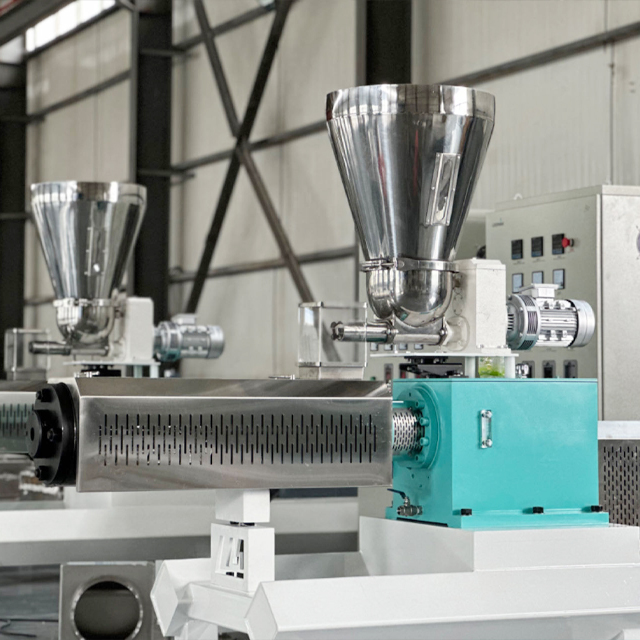
Evaluating capabilities requires looking at how each system handles real-world processing challenges. Ingredient flexibility, shear dynamics, and operational efficiency separate the two technologies on the factory floor.
Single-screw extruders suffer from slippage when fat content exceeds 8%. This causes unpredictable production halts. Twin-screw systems can handle fats up to 25%. They utilize positive displacement and dedicated kneading zones to emulsify ingredients effectively without losing forward momentum. We often see pet food manufacturers struggle with this when trying to increase fresh meat inclusions.
Moisture variations dictate product categories. Twin-screw extruders easily transition from dry expanded snacks to High Moisture Meat Analogues (HMMA). HMMA requires up to 80% moisture. Single-screw systems are strictly limited to a maximum of 30% moisture. You simply cannot texturize plant proteins into meat-like fibers without high moisture and intense, controlled shear.
Fiber and inclusion tolerances also differ. Twin-screw barrels can blend high-fiber ingredients like upcycled spent grains or pulses. They do this without blocking the flow or causing erratic torque fluctuations. This opens up opportunities for novel, health-focused product lines that would otherwise jam a simpler machine.
Twin-screw systems allow operators to vary screw speed independently of the feed rate. This decouples throughput from shear. You can control Specific Mechanical Energy (SME) precisely. In single-screw systems, changing screw speed changes both throughput and mechanical energy input simultaneously. This coupling makes it very difficult to fine-tune product expansion without altering your production rate.
Thermodynamic efficiency relies on balancing SME and Specific Thermal Energy (STE). Twin-screw barrels feature independent heating and cooling zones along the length of the barrel. This allows precise temperature profiling for enzyme inactivation, starch gelatinization, or protein denaturation. You can heat the material intensely in zone three and cool it rapidly in zone five.
Viscous dissipation control is critical for high-viscosity formulations. Intermeshing screw profiles distribute heat evenly. This mitigates hotspots that could otherwise degrade heat-sensitive nutrients or cause localized burning within the food matrix. Uncontrolled viscous heating ruins product flavor and color.
Intermeshing twin-screws continuously wipe each other’s surfaces. They also wipe the inner barrel wall. This self-wiping profile prevents product stagnation, carbonization, and burning. It maintains product safety and quality over long production runs. You do not get the burnt black specks in your final product that often plague older single-screw lines.
Twin-screw systems facilitate rapid recipe changeovers. They achieve minimal cross-contamination through automated purging runs. Single-screw systems often require complete mechanical disassembly for manual barrel cleaning. This significantly increases downtime between different product runs. Pulling a hot screw out of a barrel manually is dangerous and time-consuming.
Wear patterns and metallurgy impact long-term operations. Twin-screw systems experience wear on segmented elements. These elements are individually replaceable. Single-screw systems require the replacement of the entire screw or complete barrel rebuilding when wear compromises operational tolerances. Replacing a few kneading blocks is much faster than machining a massive solid screw.
Matching the mechanical profile to the product specification ensures operational success. Different food categories demand specific extrusion capabilities. You must align your product portfolio with the correct machinery.
Product Category | Recommended Technology | Primary Reason |
|---|---|---|
Direct-Expanded Corn Snacks | Single-Screw | Relies on stable friction-cooking of uniform raw grits. |
High Moisture Meat Analogues (HMMA) | Twin-Screw | Requires high moisture handling and precise protein alignment. |
Standard Pet Kibble | Single-Screw | Low fresh meat inclusion; fat is coated downstream. |
Premium Pet Food (High Fresh Meat) | Twin-Screw | Positive displacement prevents slipping with high fat/moisture slurries. |
Co-Extruded Filled Snacks | Twin-Screw | Requires exact density control to match outer shell and core filling. |
Traditional Pasta | Single-Screw | Low-temperature, low-shear forming minimizes starch gelatinization. |

Direct-Expanded Corn and Rice Snacks process perfectly on these machines. Puffs, curls, and balls rely on friction-cooking. Raw grits process highly stably and uniformly under these conditions. The simplicity of the machine matches the simplicity of the recipe.
Traditional Pasta and Noodles require low-temperature, low-shear forming. Starch gelatinization must be minimized to maintain structural integrity. The goal is forming, not cooking. The friction-based mechanics work well when kept at low speeds.
Standard, Grain-Heavy Pet Kibble processes well here. Mid-tier pet foods use minimal fresh meat slurry or fat inclusions in the extruder barrel. Downstream fat coating systems are applied post-drying. As long as the barrel mix stays relatively dry and uniform, the machine runs continuously.
Textured Vegetable Protein (TVP) and High Moisture Meat Analogues (HMMA) demand advanced mechanics. These are necessary for the alignment of plant protein molecules. They form linear fibers using specialized cooling dies. You need the intense, controlled shear of intermeshing screws to unfold the proteins.
Premium Pet Food with High Fresh Meat Inclusions requires positive displacement. These systems directly process raw meat slurries. They handle up to 40% inclusion without slipping or barrel surging. The screws force the slippery material forward into the die.
Complex, Co-Extruded Products like filled pillows or tubes require precision. The outer shell expansion must match core filling rates under tight density control. If the outer shell surges, the filling blows out the side of the product. Micro-Aquafeed also falls here. Producing feeds down to 0.5 mm in diameter requires exact conditions. Precise density control achieves distinct floating or sinking characteristics.
Capital expenditure and operational expenses dictate the financial viability of your processing line. You must weigh the initial outlay against the long-term production capabilities.
The baseline purchase price for twin-screw systems is higher due to complex gearboxes, segmented screws, and advanced PLC control integration. You are paying for mechanical precision and modularity. Single-screw machines are mechanically simpler, requiring less upfront capital.
Ancillary equipment footprint also impacts CapEx. Advanced extrusion lines require secondary equipment capital. This includes steam pre-conditioners, loss-in-weight feeders, liquid injection pumps, and specialized cooling dies. You must account for the entire system, not just the extruder barrel.
Maintenance costs differ significantly. Twin-screw machines require specialized maintenance for thrust bearings and gearbox oil changes. However, their self-wiping nature reduces daily cleaning labor. Single-screw machines require more manual labor for barrel cleaning and unjamming.
Energy consumption per ton of product varies based on the formulation. Twin-screw machines often utilize energy more efficiently due to targeted heating and cooling zones. They waste less energy on uncontrolled friction. Yield rates also impact OpEx. Faster changeovers and reduced startup waste on advanced machines lower the cost per kilogram of finished product.
Before finalizing any equipment purchase, you must validate your formulations on the actual machinery. Theoretical specifications do not always translate perfectly to the factory floor.
Define your raw material specifications, including particle size distribution, moisture content, and fat percentages.
Determine your required throughput rates and acceptable variance levels.
Schedule pilot plant trials with the equipment manufacturer using your exact ingredients.
Measure the Specific Mechanical Energy (SME) required to achieve your target product texture during the trials.
Evaluate the ease of cleaning and screw reconfiguration during the pilot testing phase.
Running pilot tests exposes hidden formulation issues. A recipe that works in a lab-scale mixer might bridge in a loss-in-weight feeder or surge in the extruder barrel. Testing validates the mechanical choice.
Selecting the optimal extrusion technology defines your production capabilities. Follow these steps to align your equipment with your processing goals.
Audit your current and future product formulations to determine maximum moisture and fat requirements.
Analyze your required throughput flexibility and recipe changeover frequency to assess the need for self-wiping mechanisms.
Evaluate your facility's capacity for handling modular screw configurations and advanced PLC controls.
Consult with equipment engineers to run pilot tests on your specific raw materials before finalizing machinery specifications.Selecting the right extrusion technology is essential for achieving consistent product quality, efficient production, and long-term operational success. Understanding the differences between twin screw and single screw food extruders enables manufacturers to choose equipment that best matches their formulations, production capacity, and future growth plans.
At LOOMAK, we specialize in advanced food extrusion equipment and customized production solutions for manufacturers worldwide. With extensive engineering expertise and innovative extrusion technologies, we help customers improve product quality, optimize production efficiency, and build reliable, scalable food processing lines.
Before selecting an extrusion system, evaluate your product portfolio, ingredient characteristics, production targets, and future expansion requirements to ensure the best long-term investment and manufacturing performance.
A: It is highly limited. Single-screw extruders rely on friction. High moisture and fat from fresh meat cause slippage, halting forward movement. They typically max out at very low fresh meat percentages compared to twin-screw systems.
A: Specific Mechanical Energy (SME) measures the mechanical work transferred into the food matrix. It directly controls starch gelatinization, protein texturization, and melt viscosity. Precise SME control ensures consistent product texture and expansion.
A: Depending on the machine size and design, changing segmented screw elements can take anywhere from two to six hours. However, simple recipe changes without reconfiguring the screw profile can be done rapidly via automated purging.
A: Yes. They possess complex gearboxes and multiple segmented elements. While daily cleaning is easier due to self-wiping, mechanical maintenance requires specialized training to manage thrust bearings and precise screw alignments.
A: No. High Moisture Meat Analogues require moisture levels up to 80% and precise thermal/shear decoupling to form protein fibers. Single-screw systems lack the positive displacement and modular cooling dies necessary for this process.


