Views: 0 Author: Site Editor Publish Time: 2026-07-22 Origin: Site
In continuous food manufacturing, the margin between a premium, highly expanded product and unsalable waste is dictated by micro-adjustments in thermo-mechanical processing. Processors struggle to maintain consistent product quality—such as bulk density, texture, and starch gelatinization—while maximizing throughput and minimizing energy consumption. Unstable processes lead to high scrap rates, equipment wear, and unpredictable downtime. Achieving operational stability and product consistency requires mastering the interdependent relationship of core processing variables. This guide breaks down how moisture, temperature, and screw speed interact on the production floor. We provide a technical framework for evaluating process adjustments, troubleshooting quality defects, and specifying the right extrusion equipment for your specific product lines.

Parameter Interdependence: Moisture, temperature, and screw speed cannot be adjusted in isolation; altering one fundamentally shifts the Specific Mechanical Energy (SME) and melt viscosity of the entire system.
Moisture as a Plasticizer: Precise moisture control is the primary driver for starch gelatinization and final product expansion ratios.
Thermal vs. Mechanical Energy: Effective extrusion balances external barrel heating with internal viscous dissipation generated by the screw extruder.
Equipment Evaluation: Upgrading or scaling extrusion lines requires prioritizing equipment with high-resolution sensor arrays, dynamic zonal temperature control, and modular screw configurations.
Table of Contents
Defining process stability is the first step toward optimization. A successful extrusion operation requires a steady-state flow where mass and energy inputs perfectly match the desired structural transformation of the extrudate. When material enters the barrel, it undergoes rapid physical and chemical changes. You must balance these inputs to prevent surging, blockages, or undercooked product. Operators cannot simply change one setting and walk away. Every adjustment triggers a chain reaction inside the barrel.
Specific Mechanical Energy (SME) serves as the critical metric for evaluating extrusion efficiency. Process engineers rely on SME to quantify the mechanical energy transferred from the main motor directly into the dough. This energy input dictates texture, cell structure, and overall cook level. You calculate SME by dividing the actual motor power applied by the total mass throughput. Monitoring SME in real-time allows operators to detect subtle shifts in raw material lots or moisture variations before they result in out-of-spec products. When SME drops unexpectedly, you know the melt viscosity has changed, likely due to a moisture spike or a drop in raw material density.
The conceptual trade-offs between moisture, temperature, and screw speed form the foundation of process control. Moisture provides lubrication. Temperature delivers thermal energy. Screw speed dictates shear and mechanical energy. A change in one variable requires immediate compensatory adjustments in the others. If you increase moisture, viscosity drops. This reduces mechanical shear, lowering the SME. To maintain the same cook level, you must then increase barrel temperatures or increase screw speed to compensate for the lost frictional heat. Mastering these food extrusion parameters separates profitable runs from scrap-generating disasters.
Die resistance, feed rate, and barrel fill form the fourth pillar of process control. Feed rate and die restriction interact directly with screw speed to determine how full the barrel gets. This dictates system pressure. A highly restricted die increases pressure and barrel fill, which forces the material to undergo more intense shear. It also extends the residence time inside the barrel, altering the final product characteristics. You must monitor die pressure constantly. A sudden drop indicates material starvation or excessive moisture, while a spike warns of an impending blockage.
Establish a baseline SME for every product recipe during optimal running conditions.
Monitor main drive motor torque as the primary indicator of melt viscosity changes.
Adjust feed water injection before altering barrel temperatures to correct minor viscosity fluctuations.
Verify die open area calculations when scaling up throughput to maintain consistent barrel fill.
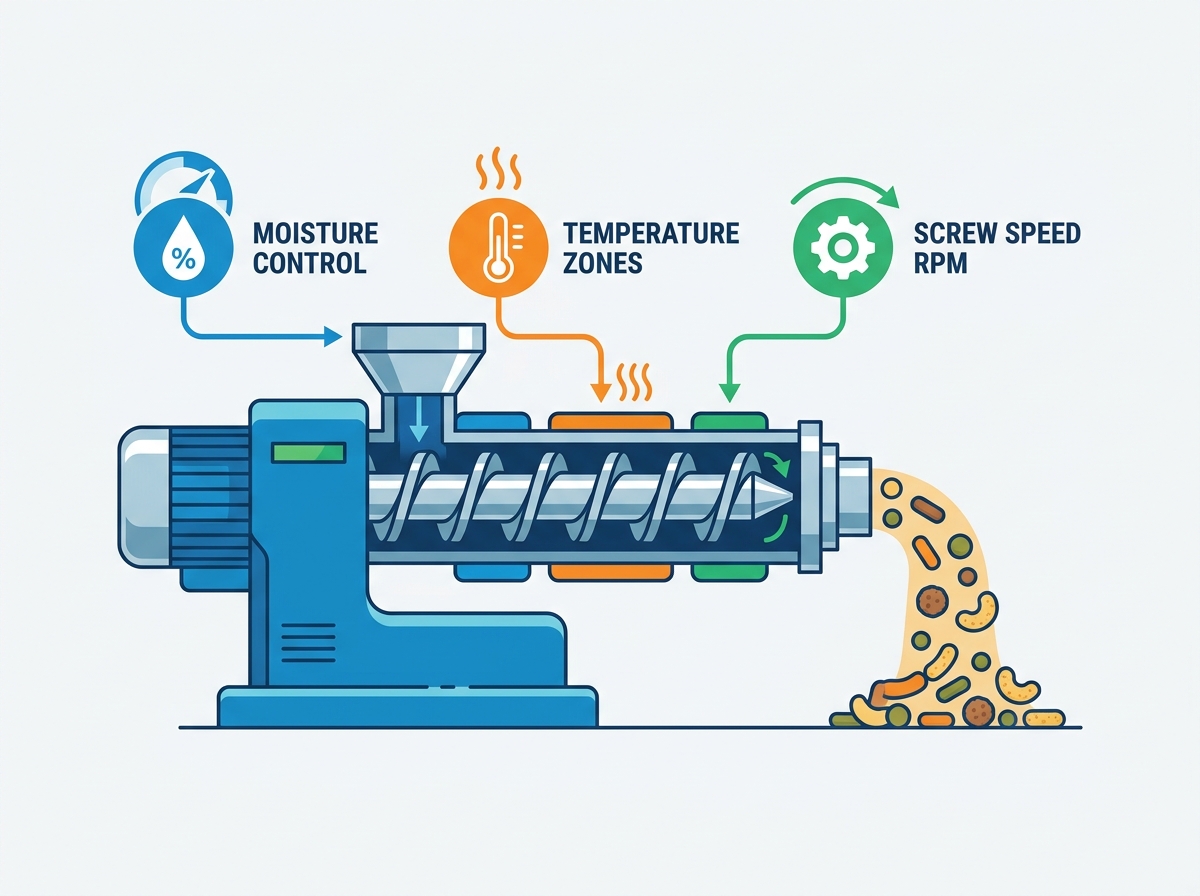
Water acts as a powerful plasticizer during the extrusion process. It physically separates polymer chains, reducing the glass transition temperature of biopolymers like starches and proteins. This lowers the overall melt viscosity inside the barrel. Proper hydration ensures the material flows smoothly through the restrictive die openings rather than burning or clogging the system. Without adequate moisture, the friction generated by the screws will literally scorch the raw materials into carbonized rock.
Complete starch gelatinization and protein denaturation require specific minimum moisture thresholds. If moisture is too low, the material suffers excessive thermal degradation from extreme shear forces. If moisture is too high, the material passes through the barrel without absorbing enough mechanical energy to fully cook. You must find the precise hydration point that allows structural transformation without destroying the nutritional profile. This sweet spot varies heavily depending on the amylose-to-amylopectin ratio of your starch source.
Raw feedstock characteristics heavily impact water absorption kinetics. Fine flours hydrate rapidly during the pre-conditioning stage. Coarse semolina grits require significantly more time for water to penetrate the particle core. Uneven hydration leads to ungelatinized "white spots" in the final product. Adjusting pre-conditioner retention time and mixing intensity is mandatory when changing raw material particle size distributions. You cannot run a coarse corn meal using the same pre-conditioning parameters as a fine wheat flour.
Feed moisture shares an inverse relationship with radial expansion at the die. Higher moisture levels typically reduce product expansion and increase bulk density. This happens because the wetter melt has lower elastic recovery. Furthermore, the vapor pressure at the die discharge drops when the melt contains excessive water. If you want a light, highly expanded snack, you must run at lower moisture levels to maximize flash-evaporation as the product exits the high-pressure barrel environment into the atmosphere.
Inadequate moisture control introduces severe implementation risks. Operators often face unstable motor loads when moisture fluctuates. Dry pockets cause raw material slippage along the screw channel. This leads to surging at the die face, where product shoots out in unpredictable bursts. In worst-case scenarios, insufficient lubrication causes catastrophic die blockages. Clearing a blocked die requires complete equipment teardowns, costing hours of lost production time and exposing maintenance crews to severe burn hazards.
Modern extruders require distinct temperature zones within the barrel to manage the product's thermal history. The feeding zone must remain cool to prevent premature gelatinization and bridging in the feed throat. If material cooks in the feed throat, it blocks incoming powder, starving the machine. The kneading zone requires elevated temperatures to initiate cooking and melt the biopolymers. Finally, the forming zone temperature must be precisely controlled to optimize melt viscosity right before the die.
Effective extrusion balances external heat applied via barrel jackets with internal heat generated by friction. This internal friction is known as viscous dissipation. In high-shear applications, the mechanical energy alone often exceeds the thermal requirements of the product. Therefore, robust cooling capacity is frequently more critical than heating capacity to prevent burning. You will often see the final barrel zones running full cooling water just to keep the melt temperature below the degradation threshold.
Thermal Control Method | Primary Advantage | Common Application | Limitation |
|---|---|---|---|
Electrical Cartridge Heaters | Rapid heating response and high maximum temperatures. | Low-moisture snack foods requiring intense heat. | Provides no cooling capability; requires separate cooling jackets. |
Circulating Fluid (Oil/Water) | Excellent temperature stability and dual heating/cooling capability. | Textured vegetable proteins and heat-sensitive recipes. | Slower response time compared to direct electrical heating. |
Direct Steam Injection | Instantaneous heat transfer and added moisture. | Pre-conditioning stages for pet food and aquafeed. | Can over-hydrate the mix if not carefully regulated. |
The temperature profile must transition raw crystalline starches into a fully amorphous, flowable melt state. You must navigate the glass transition and melting phases smoothly. If the temperature ramps up too quickly, the outer layer of the material melts while the core remains raw. Gradual, controlled thermal input ensures a homogenous melt stream reaches the die plate. This requires mapping out the exact temperature setpoints for each individual barrel segment based on the specific recipe.
Precise thermal control mitigates the Maillard reaction. Unwanted browning and off-flavors ruin product appeal. Excessive heat also causes the thermal degradation of heat-sensitive vitamins, amino acids, and functional proteins. By utilizing aggressive barrel cooling in the final zones, you can arrest these chemical reactions just before the product exits the system. This is especially critical when running pet foods fortified with synthetic vitamins that degrade rapidly above 120 degrees Celsius.
When evaluating thermal control systems, consider thermocouple placement. Sensors buried deep in the barrel wall measure steel temperature, not product temperature. Look for equipment that positions sensors closer to the melt stream for accurate real-time data. Fluid heating systems offer better stability, while electrical systems provide faster initial heat-up times. Your choice depends entirely on whether your primary challenge is getting heat into the product or pulling excess frictional heat out of it.

Altering the speed of a screw extruder directly impacts the time raw materials spend inside the barrel. This Residence Time Distribution dictates the degree of cook and overall product homogeneity. Faster speeds push material through quickly, reducing cook time. Slower speeds increase retention, allowing for more thorough starch gelatinization but risking thermal degradation. You must match the screw speed to the feed rate to maintain a consistent barrel fill level.
Higher screw speeds drastically increase mechanical shear rates. This elevates SME and drives up the melt temperature through friction. While high shear is necessary for expansion, it can lead to macromolecular degradation if poorly managed. Dextrinization of starches occurs when shear forces physically tear polymer chains apart, resulting in a sticky, unworkable melt that collapses after exiting the die. Operators must watch for sudden drops in die pressure at high speeds, which often indicates the starch matrix has been destroyed.
The selection and arrangement of modular screw elements directly control shear input and pressure generation. Forward conveying elements simply move material downstream with minimal mixing. Reverse screw elements create deliberate flow restrictions, forcing the material to back up and undergo intense mixing. Kneading blocks of varying angles chop and fold the dough, ensuring uniform hydration and thermal distribution. Designing the correct screw profile is an engineering exercise in balancing conveying capacity against mixing intensity.
Single-screw systems are highly dependent on feed moisture, friction, and slip to convey material. They have narrow parameter tolerances. Twin-screw systems operate on positive displacement. This allows for significantly greater flexibility in moisture levels, viscosity changes, and speed variations. Twin-screw platforms recover from process upsets much faster than their single-screw counterparts because the intermeshing screws wipe each other clean, preventing material buildup and degradation.
High screw speeds accelerate wear on screw elements and barrel liners. You must manage wear rates to maintain production efficiency. As clearances between the screw and barrel increase, conveying efficiency drops and shear profiles change. Material slips backward over the screw flights, reducing throughput and increasing residence time unpredictably. Mitigate this wear by specifying advanced metallurgy, such as nitrided steel, bimetallic liners, or PM-HIP alloys, for high-wear zones like the final compression section.
Direct-expanded snacks require a highly specific parameter profile. You typically run low feed moisture, around 12 to 18 percent. Barrel temperatures must be high, often between 120 and 160 degrees Celsius. You need high screw speeds to maximize shear and SME. This combination ensures the rapid flash-evaporation of water at the die, creating the signature crispy, airy texture. If moisture creeps up or temperatures drop, the product exits as a dense, chewy rope instead of a puffed snack.
Textured Vegetable Protein production varies wildly depending on the desired end product. Dry TVP utilizes medium moisture and high shear to create a spongy, porous structure that absorbs water rapidly upon rehydration. Wet TVP, or High Moisture Extrusion, uses 50 to 70 percent moisture and very low shear. It relies on long cooling dies to align protein molecules into a dense, fibrous, meat-like structure without puffing at the exit. The thermal and mechanical profiles for these two products are complete opposites.
Pet food and aquafeed require a balanced approach. You operate at medium moisture levels, typically 20 to 30 percent, with moderate shear. The goal is complete starch gelatinization to bind the pellet together, ensuring structural integrity during handling and transport. Precise temperature and moisture control dictate the final bulk density, allowing you to reliably manufacture feeds that either float or sink depending on the target species. Floating feeds require higher expansion, while sinking feeds require aggressive venting to remove trapped steam before the die.
Modern extrusion demands high-resolution sensor arrays and real-time data acquisition. You cannot optimize what you cannot measure. Equipment must feature accurate mass flow meters for both dry ingredients and liquid injections. Without precise dosing, your moisture-to-shear ratio will constantly fluctuate, making steady-state operation impossible. Volumetric feeders are no longer sufficient for high-performance extrusion lines; loss-in-weight gravimetric feeders are mandatory for maintaining consistent mass balances.
Look for control systems that automatically adjust to process variations. If the main drive motor detects a spike in torque, the system should automatically modulate feed rates or water injection to prevent a stall. Advanced PLCs log historical data, allowing process engineers to track SME trends over time and predict when screw elements need replacement based on performance degradation rather than guesswork. The ability to trend die pressure, melt temperature, and motor load on a single screen empowers operators to make informed, data-driven adjustments.
Optimizing food extrusion parameters is the key to achieving stable production, consistent product quality, and improved manufacturing efficiency. By accurately controlling moisture, temperature, screw speed, and process monitoring, manufacturers can reduce waste, enhance product performance, and maximize long-term production reliability.
At LOOMAK, we provide advanced food extrusion equipment and customized processing solutions for manufacturers worldwide. Our experienced engineering team helps customers optimize extrusion processes, improve product consistency, and achieve higher productivity through reliable technology and professional technical support.
Before adjusting production parameters or investing in new equipment, evaluate your product requirements, raw material characteristics, process data, and equipment capabilities to achieve the most efficient and reliable extrusion performance.
A: Increasing the feed rate while maintaining a constant screw speed causes the barrel to fill up more completely. This higher fill level forces more material against the restrictive die plate, directly increasing the internal system pressure and altering the shear profile.
A: High bulk density usually results from excessive moisture in the feed mix or insufficient thermal energy. Too much water lowers melt viscosity and reduces the vapor pressure needed for flash-evaporation at the die. Try reducing feed moisture or increasing barrel temperatures.
A: Single-screw extruders rely on friction to move material forward, making them sensitive to moisture and fat content. Twin-screw extruders use positive displacement, where the intermeshing screws force material forward regardless of friction, allowing for greater recipe flexibility and precise control.
A: Reverse screw elements push material backward against the main flow. This creates a high-pressure zone that forces the material to fully fill the barrel section, resulting in intense mechanical shearing, thorough mixing, and a rapid increase in product temperature.
A: While possible, it is not ideal. High-moisture extrusion often requires precise cooling to align proteins and prevent expansion at the die. Electrical heaters provide no cooling capability. Circulating fluid systems are much better suited for managing the complex thermal requirements of high-moisture products.
A: Surging is typically caused by inconsistent feeding, uneven moisture distribution, or worn screw elements. When material slips inside the barrel instead of conveying forward steadily, pressure builds and releases erratically, causing the product to shoot out of the die in bursts.


