Views: 0 Author: Site Editor Publish Time: 2026-07-22 Origin: Site
In high-volume snack manufacturing, texture dictates product success. Crispness, crunchiness, and melt-in-the-mouth sensations drive consumer repeat purchases. Yet, texture remains the most difficult variable to control at scale. Legacy extrusion systems often struggle with batch-to-batch variability. They limit manufacturers to simple starch bases, resulting in inconsistent expansion ratios and high scrap rates. Mouthfeel often suffers when introducing complex ingredients like plant proteins or high-fiber grains.
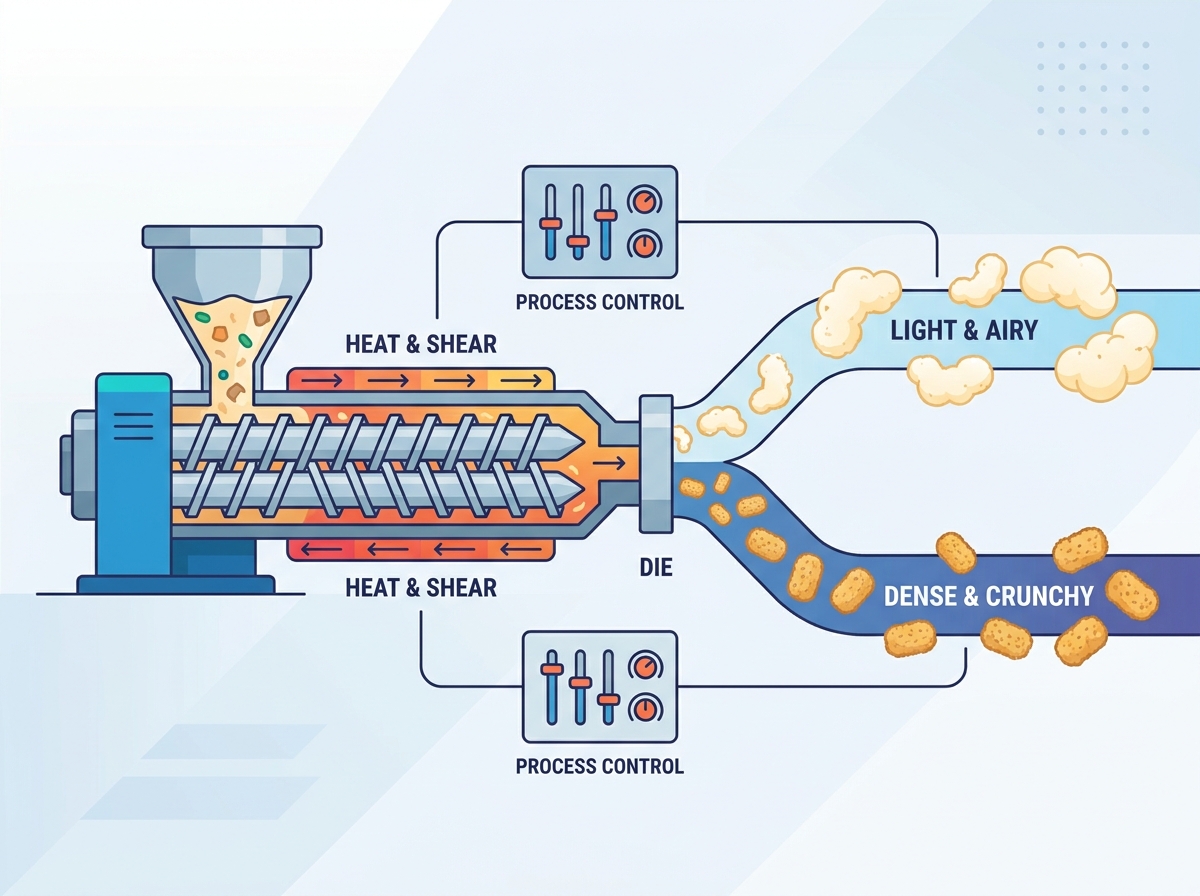
Achieving precise, repeatable texture requires exact control over thermomechanical energy. You must manage shear, temperature, and pressure simultaneously. This guide evaluates how modern twin screw extrusion puffed snacks systems address formulation challenges. We provide the operational framework necessary for evaluating and implementing a high-performance production line.

Predictable Expansion: Twin-screw systems decouple throughput from screw speed, allowing for precise manipulation of Specific Mechanical Energy (SME) to control starch gelatinization and final product expansion.
Formulation Flexibility: Unlike single-screw machines, a twin screw extruder handles high-moisture, high-fat, and high-protein recipes without surging or losing pressure, enabling the production of premium, better-for-you snacks.
Modular Control: Customizable screw profiles (mixing, kneading, and conveying elements) allow R&D teams to engineer exact shear profiles tailored to specific texture profiles.
Table of Contents
Establishing quantitative success criteria for snack texture is the first operational step. You cannot manage what you do not measure on the production floor. Key metrics include the Expansion Index (EI) and bulk density. Crispness work requires measurement via texture analyzers equipped with Kramer shear cells or cylinder probes. Acoustic emission testing also provides valuable data on crunch intensity, capturing the sound waves generated when cell walls fracture. These metrics form the baseline for your quality control parameters.
Biopolymers undergo extreme phase transitions inside the extruder barrel. Understanding starch chemistry helps predict these changes. Amylose provides structural strength and crispness. It forms a linear matrix that resists immediate collapse. Amylopectin promotes high expansion but creates weaker, highly branched cell walls. Corn, rice, tapioca, and potato starches all possess different ratios of these molecules. You must balance them to achieve your target mouthfeel.
Starch Source | Amylose Content (%) | Amylopectin Content (%) | Impact on Extrudate Texture |
|---|---|---|---|
Corn | 25-28 | 72-75 | Balanced expansion, high crispness, strong cell walls. |
Tapioca | 15-18 | 82-85 | Extreme expansion, light texture, rapid melt-in-mouth. |
Potato | 20-22 | 78-80 | Moderate expansion, dense crunch, prone to glassiness. |
Rice | 18-20 | 80-82 | Fine cell structure, delicate crispness, smooth surface. |
The sudden pressure drop at the die face triggers instantaneous thermodynamic flashing. Pressure drops from over 100 bar inside the barrel to atmospheric pressure in milliseconds. Superheated water instantly converts into steam. This rapid phase change dictates bubble nucleation. It determines cell wall thickness and final product density. Controlling this pressure differential is critical for uniform expansion. If the pressure is too low, the water boils off slowly, resulting in a dense, hard pellet rather than a puffed snack.
Varying ingredient levels disrupt the starch matrix. You must account for these disruptions during formulation:
Lipids act as lubricants inside the barrel, reducing mechanical shear and overall expansion.
Insoluble fibers physically tear delicate cell walls during nucleation, causing structural collapse.
Proteins increase product hardness and require higher thermal energy for adequate plasticization.
Sugars compete with starch for available water, altering the gelatinization temperature.
Operational mechanics differ vastly between extrusion platforms. Intermeshing co-rotating twin screws provide positive displacement. They ensure consistent self-wiping flow regardless of ingredient slip. The flight of one screw wipes the root of the other. Single screws rely entirely on barrel wall friction to move material forward. They remain highly prone to surging, stagnation, and inconsistent output, especially when processing recipes with high oil or moisture content.
Independent parameter control gives operators a distinct advantage. You can decouple feed rate, screw speed, and temperature profile. This mechanical feature allows for fine-tuning texture on the fly. You can adjust shear rates without altering production volumes or pressure limits. A twin screw extruder provides this necessary flexibility, allowing you to dial in the exact Specific Mechanical Energy required for a specific recipe.
Longer Length-to-Diameter (L/D) ratios expand process flexibility. Ratios typically range from 24:1 to 40:1 in twin-screw systems. This length allows for multiple processing zones within a single pass. You can integrate feeding, mixing, shearing, venting, and cooking seamlessly. Single-screw extruders lack the physical space for this segmented processing, limiting their use to simple, pre-conditioned grain meals.
Processing difficult recipes requires robust mechanical handling. Lentil, chickpea, and pea protein bases challenge standard equipment due to their narrow processing windows. Co-extruded and center-filled puffed snacks require precise pressure stabilization at the die face to prevent the outer shell from blowing out. Twin-screw systems maintain consistent melt viscosity. They prevent pressure fluctuations that ruin complex formulations.
Engineering a modular screw profile dictates shear rate management. Strategic placement of elements controls the entire process from dry feed to melt pump. Forward conveying elements manage bulk material transport, featuring wide pitches in the feed zone to handle low-density powders. Kneading blocks control residence time distribution (RTD). They manage mechanical energy dissipation and shear intensity. Distributive and dispersive mixing elements ensure uniform melt temperature and ingredient homogeneity.
Forward conveying elements move dry ingredients rapidly away from the feed port.
Neutral kneading blocks (staggered at 90 degrees) increase mixing without aggressive forward movement.
Reverse kneading blocks create melt seals, backing up material to maximize shear and barrel fill.
Dispersive elements break down hard particles for a smooth, uniform melt.
Specific Mechanical Energy (SME) serves as the critical metric for texture. It represents the mechanical work transferred from the motor to the product. You must balance mechanical shear with thermal energy. Multi-zone induction barrel heating and cooling help achieve optimal melt viscosity before the die. Precise SME control prevents under-cooking, which leaves gritty starch centers, or burning, which degrades flavor and color.
Water acts as both a plasticizer and a blowing agent. Moisture content dictates plasticization dynamics inside the barrel. It reduces melt viscosity and lowers the glass transition temperature. Proper moisture management ensures the starch matrix can stretch during expansion. Too little water causes glassiness and excessive motor torque. Too much water prevents crispness, resulting in a chewy, unappealing texture.
Die design and cutter speed mechanics finalize the product shape. Die land length, open area ratio, and geometry dictate the shear rate at the exit. A longer die land increases backpressure and aligns the polymer chains for a smoother surface finish. Cutter speed and blade angle prevent tailing. Proximity to the die face prevents deformities. Precise cutting ensures snack symmetry and a consistent mouthfeel.

Scaling from a pilot plant to commercial production introduces significant risks. You must evaluate an equipment manufacturer's scale-up reliability. Maintaining constant shear stress and tip speed is vital. SME must remain consistent when transitioning from a 50 kg/hr lab-scale unit to a 1,000+ kg/hr commercial line. Mathematical modeling prevents costly scale-up failures, ensuring the thermodynamic profile remains identical across different barrel diameters.
Process Analytical Technology (PAT) improves in-line quality control. Integrating real-time sensors keeps texture within tight tolerance limits. High-frequency melt pressure transducers monitor die stability, alerting operators to potential blockages. In-line NIR moisture analyzers track hydration levels before the material enters the barrel. Online rheometers measure melt viscosity continuously. These sensors allow operators to auto-adjust extrusion parameters instantly, reducing scrap rates.
Sanitary design ensures stringent food safety compliance. Equipment features must align with FSMA and HACCP standards. Self-wiping screw profiles prevent product stagnation and bacterial growth inside the processing section. Hygienic open-frame barrel designs allow for rapid inspection and washdown. Clean-in-place (CIP) capabilities reduce downtime between allergen changeovers, a critical requirement for facilities handling both dairy-based and vegan snack lines.
Energy efficiency impacts long-term operational viability. High-torque direct-drive motors reduce power loss compared to older belt-driven systems. Advanced split-flow gearboxes handle high loads efficiently, distributing torque evenly across both screw shafts. You must balance these efficiencies against maintenance requirements. Replacing high-wear screw elements and barrel liners requires planned downtime. Robust metallurgy minimizes these operational disruptions.
Subsequent unit operations can ruin engineered texture. Post-extrusion drying and seasoning impacts are severe. Structural collapse occurs if moisture is not systematically dried down. You must reduce moisture from 15% out-of-die to under 3% for shelf stability. Fluid-bed or belt dryers handle this process, using controlled temperature zones to prevent case hardening. Applying seasoning slurries requires care to avoid re-hydrating the outer crisp shell, which destroys the crunch.
Managing twin-screw variables involves a steep learning curve. Operator training gaps lead to inconsistent product quality and equipment damage. We recommend utilizing manufacturer-provided training simulators to build muscle memory without wasting raw materials. Recipe-driven PLC automation systems reduce human error by locking in proven parameters. Standardized troubleshooting operating procedures (SOPs) help operators respond to process deviations quickly and safely.
Raw material variability causes formulation drift. Inconsistent supplier ingredients disrupt the extrusion process. Varying starch ratios, particle size distributions, or crop-to-crop moisture changes alter melt viscosity. You must use real-time torque and die pressure feedback loops. These loops auto-adjust parameters to compensate for ingredient inconsistencies, ensuring the final product remains within specification regardless of minor raw material fluctuations.
Processing abrasive ingredients accelerates metallurgical wear. Whole grains, pulses, and fibers degrade barrels and screw elements rapidly. You must invest in specialized high-wear alloys. Nitrided steels or powder metallurgy (PM) coatings extend component lifespan significantly. Preventing wear prevents gradual drift in your target texture profile, as worn screw flights lose their ability to generate adequate shear and pressure.
Twin screw extrusion technology provides manufacturers with greater control over product texture, formulation flexibility, and production efficiency. By optimizing processing parameters and selecting the right extrusion equipment, businesses can consistently produce high-quality puffed snacks while reducing waste and improving long-term operational performance.
At LOOMAK, we specialize in advanced twin screw food extrusion equipment and customized production solutions for snack manufacturers worldwide. Our experienced engineering team helps customers optimize product development, improve manufacturing efficiency, and achieve reliable, high-quality production through innovative extrusion technology.
Before investing in a twin screw extrusion system, evaluate your product goals, ingredient characteristics, production capacity, and future expansion plans to select the most suitable equipment and processing solution.
A: The typical moisture range within the extruder barrel is 14% to 20%. Deviations affect the glass transition temperature and melt viscosity. Lower moisture creates a denser, harder product. Higher moisture increases the expansion index but can lead to structural collapse if not dried properly.
A: Screw speed directly impacts the shear rate and Specific Mechanical Energy (SME). Higher speeds increase mechanical friction and thermal energy dissipation. This leads to finer cell sizes, a higher expansion ratio, and a lighter, crispier extrudate. Lower speeds produce denser textures.
A: Yes. Twin-screw systems easily manage the narrow processing windows of alternative proteins. They handle high water-absorption rates and structural limitations effectively. Positive displacement ensures consistent flow, preventing the surging common when processing gluten-free or pulse-based formulations in single-screw machines.
A: SME is the amount of mechanical work transferred from the motor to the product per unit mass. It serves as the primary control lever for starch gelatinization and melt viscosity. Operators adjust SME by changing screw speed, feed rate, or screw profile configuration.
A: Increase the SME by raising the screw speed or adding reverse kneading elements. You can also lower the formulation moisture levels slightly. Optimizing the die temperature or adjusting the starch profile to include more amylopectin will also improve expansion and reduce hardness.
A: Lifespan ranges from 3,000 to over 10,000 hours. This depends entirely on ingredient abrasiveness and component metallurgy. Processing high-fiber grains wears elements faster. Screw wear reduces shear capacity, which degrades texture consistency and lowers the expansion index over time.
A: An L/D ratio of 24:1 to 32:1 is typically ideal for simple starch puffs. It provides enough residence time for cooking and expansion. Ratios of 36:1 to 40:1 are better for complex proteins or multi-textured snacks requiring extended mixing and precise temperature zoning.


