Views: 0 Author: Site Editor Publish Time: 2026-07-22 Origin: Site
The extrusion die serves as the final restriction in the food processing line. It directly defines the shape, texture, expansion, and structural integrity of the end product. When operators face inconsistent product density, excessive backpressure, premature wear, or frequent line stoppages due to clogging, the root cause often traces back to improperly specified tooling. A poorly configured die disrupts the continuous cooking process, leading to material degradation and severe operational bottlenecks.
Selecting the right die requires a systematic evaluation of fluid dynamics, equipment compatibility, and metallurgical durability. The geometry of the die must match the rheological properties of the recipe while maintaining precise pressure profiles. This technical guide outlines a framework for evaluating and selecting dies and molds. You will learn how to balance flow dynamics, match configurations to specific extruder types, select wear-resistant materials, and mitigate implementation risks through advanced prototyping and simulation.

Flow Balancing is Non-Negotiable: Effective food extruder die design must ensure uniform velocity across all orifices to prevent product variation and localized burning.
System Compatibility: Die specifications must align precisely with the upstream screw extruder's throughput, pressure capabilities, and shear profile.
Material Selection Dictates Lifespan: Balancing wear resistance with food-grade compliance requires specific metallurgical choices and surface treatments based on the abrasiveness of the recipe.
Prototyping Mitigates Risk: Utilizing Computational Fluid Dynamics (CFD) and pilot testing prevents costly full-scale manufacturing errors related to die swell and pressure drops.
Table of Contents
A properly specified die must achieve several precise operational objectives simultaneously. The primary goal is maintaining strict dimensional control over the extrudate as it exits the machinery. This ensures uniform piece weight and consistent packaging volumes. Targeted expansion ratios are equally important. The die must generate the exact pressure drop required to flash off moisture instantly. This creates the desired cellular structure in expanded snacks or cereals. Uniform texture and a smooth surface finish depend entirely on the die's ability to manage shear forces without fracturing the melt. Success is measured by continuous, stable operation with zero localized burning and minimal product variation across the entire die face.
The die acts as a deliberate physical restriction at the end of the barrel. This restriction generates the immense backpressure necessary for cooking, mixing, and starch gelatinization upstream. Without adequate pressure, the mechanical energy cannot transform the raw ingredients into a cohesive viscoelastic dough. The open area of the die directly dictates this pressure. A smaller open area increases backpressure, driving up the melt temperature and mechanical shear.
The relationship between the open area and the land length determines the shear forces applied to the food melt just before exit. The land length is the straight, parallel section of the die orifice. The Land Length-to-Diameter (L/D) ratio is a technical dimension you must control. A higher L/D ratio provides more time for the polymer chains within the food melt to align and relax. This controlled relaxation reduces elastic recovery, leading to a denser product with a smoother surface. Conversely, a very short land length maximizes sudden expansion. This is ideal for highly puffed snacks but risky for structural integrity.
Food doughs behave as non-Newtonian, shear-thinning fluids. As shear rates increase within the die, the viscosity of the dough decreases. This complex rheology heavily influences optimal food extruder die design. Recipes high in starch undergo rapid gelatinization. They develop high viscosity and exhibit massive expansion potential upon exiting the die. Die geometries for starchy products must account for significant die swell and require careful land length tuning to prevent structural collapse.
Protein-heavy recipes, such as texturized vegetable proteins or meat analogs, behave differently. Protein denaturation creates fibrous, cross-linked structures with much lower expansion characteristics. Dies for high-protein applications often require longer land lengths and specialized cooling jackets to set the fibrous texture before the product exits the orifice. Understanding whether the recipe is starch-driven or protein-driven dictates the internal angles, transition zones, and final orifice dimensions.
Recipe Type | Rheological Behavior | Expansion Potential | Die Design Requirements |
|---|---|---|---|
High Starch (Corn, Wheat) | High viscosity, rapid gelatinization | Very High | Short land lengths, high open area, swell compensation |
High Protein (Soy, Pea) | Fibrous cross-linking, denaturation | Low to Moderate | Long land lengths, cooling jackets, gradual transitions |
High Fiber (Bran, Whole Grain) | Abrasive, low cohesion | Low | Hardened metallurgy, wear-resistant coatings, moderate L/D |
Industrial extrusion dies rarely feature a single hole. They contain dozens or hundreds of orifices arranged in complex patterns. The primary engineering challenge is ensuring the food melt reaches the center holes and the peripheral holes at the exact same velocity and pressure. Fluid naturally seeks the path of least resistance, typically flowing faster through the center.
Engineers use internal flow restrictors, conical distribution plates, and varying land lengths to balance this flow. If flow distribution is poor, the consequences are immediate. Products exiting the center will be longer, over-expanded, and lighter in density. Products at the periphery will be shorter, denser, and potentially undercooked. Uneven flow also leads to localized dead zones where material stagnates, burns, and eventually breaks off as black specks in the final product.
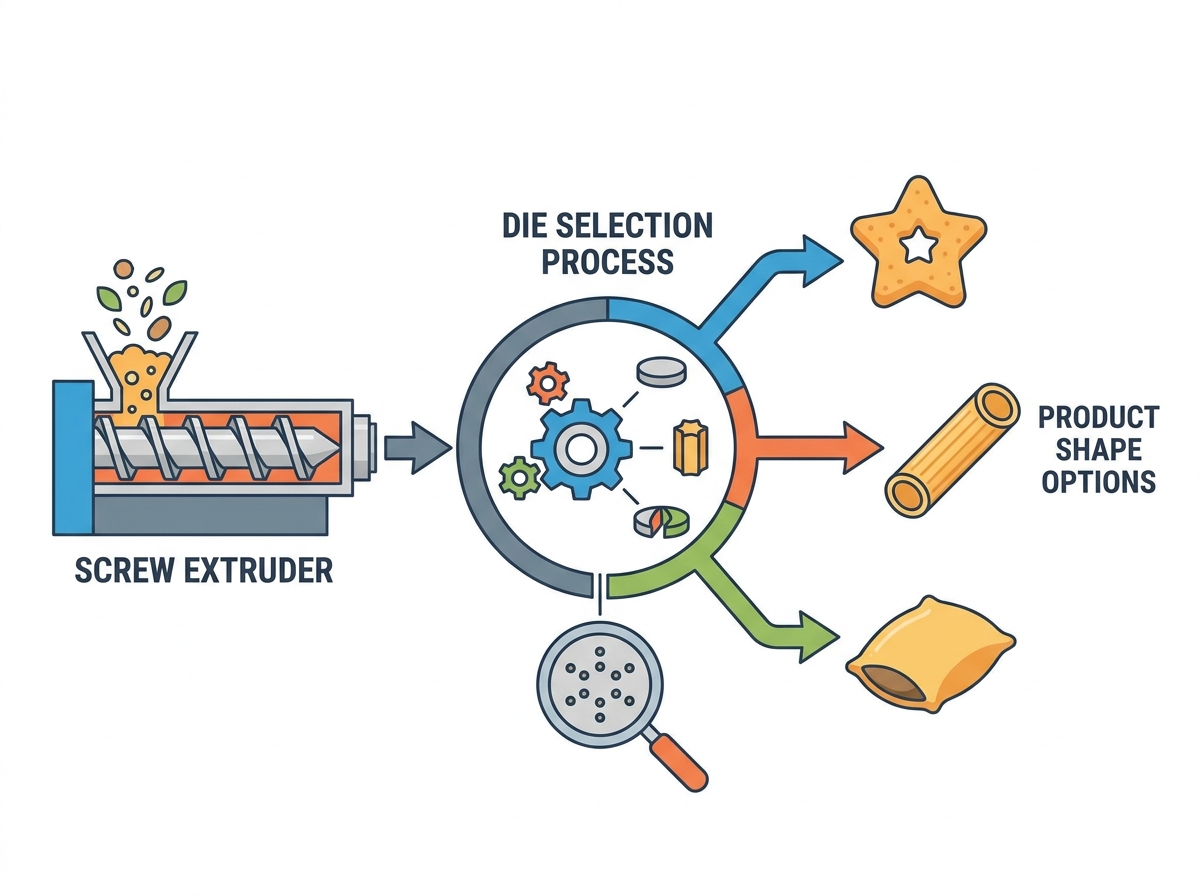
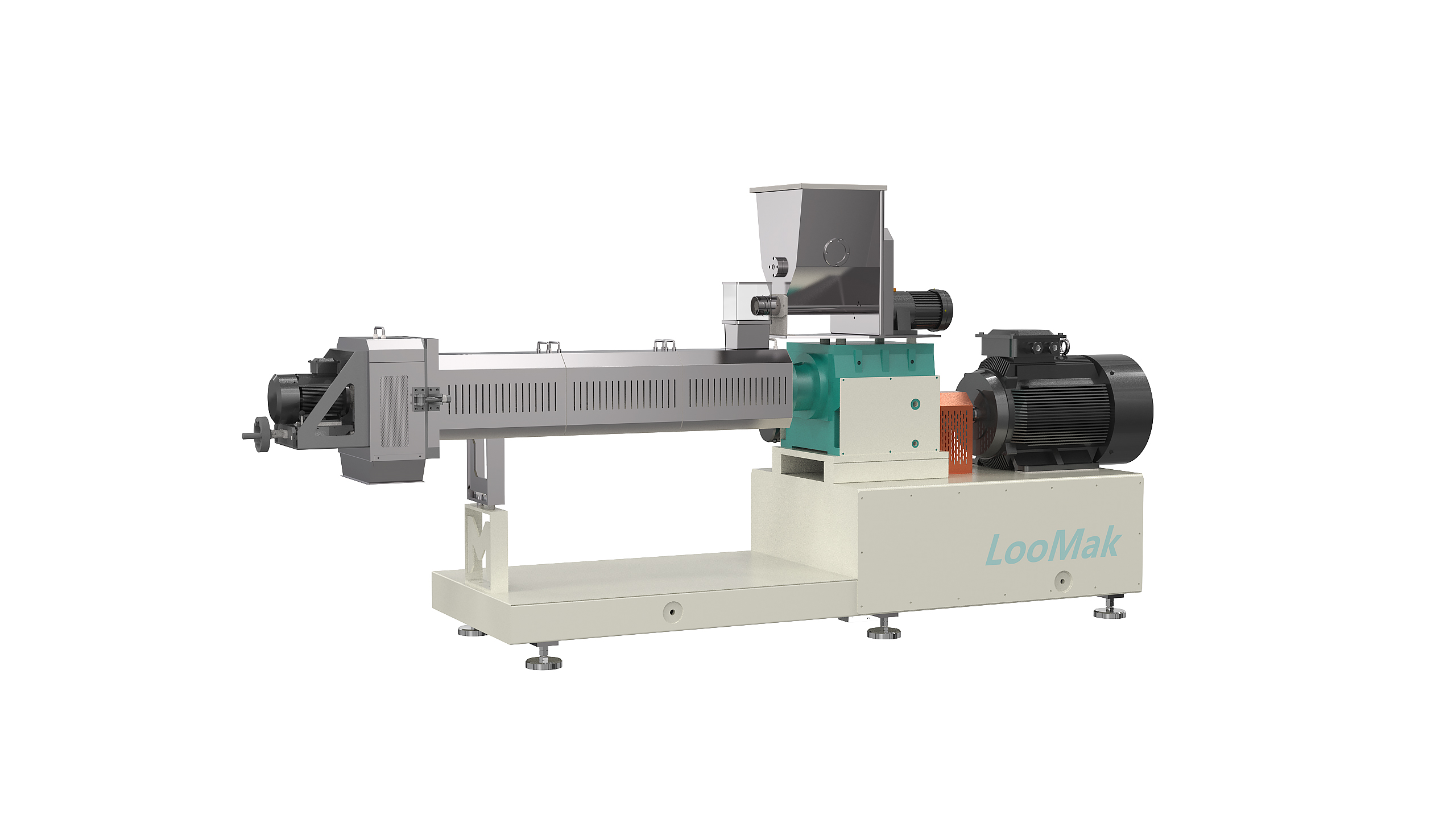
Die design parameters shift significantly depending on the upstream machinery. A single screw extruder generates pressure differently than a twin-screw system. Single-screw machines rely heavily on the die restriction to build pressure and fill the barrel. The die must be carefully sized to prevent surging and ensure adequate cooking time. Twin-screw extruders offer positive displacement. They can handle a wider range of moisture contents and ingredient viscosities. Dies for twin-screw systems can accommodate more complex shapes and higher open areas without losing the necessary upstream cooking pressure. This allows for highly precise, intricate product geometries.
Facilities must choose between solid, single-piece monolithic dies and modular carrier plates equipped with interchangeable inserts. Monolithic dies are machined from a single block of steel. They offer superior structural integrity under extreme pressures and are easier to sanitize due to the lack of internal seams. However, they lack flexibility.
Modular die assemblies use a robust carrier plate that holds multiple small die inserts. This configuration is highly advantageous for versatile production lines. Operators can change product shapes simply by swapping the inserts, rather than replacing a massive, heavy die plate. This modularity reduces physical storage requirements and allows for rapid adaptation to new market trends.
The method of cutting the extrudate dictates the die's external geometry. Face-cut dies are standard for direct expansion snacks, cereals, and pet foods. The orifices are arranged in a circular pattern on a flat plate. High-speed rotary knives spin directly against the die face, slicing the expanding melt into uniform pieces. The die face must be perfectly flat and highly wear-resistant to withstand the constant friction of the blades.
Peripheral dies are used for complex shapes, pellets, and specific pasta types. The material flows outward radially through orifices located on the circumference of a cylindrical die. The cutting mechanism rotates around the outside of this cylinder. Peripheral dies allow for a massive number of orifices and are ideal for high-throughput applications where direct face-cutting would cause product agglomeration.
Co-extrusion involves pumping two distinct materials through a single die assembly simultaneously. Center-filled snacks require highly specialized co-extrusion dies. These dies feature concentric tubes. The outer tube shapes the expanded cereal casing, while the inner tube injects the filling directly into the hollow center.
Managing two distinct rheological flows is complex. The outer shell is typically a high-viscosity, high-temperature melt. The inner filling is often a low-viscosity, fat-based pumpable fluid. The die must thermally isolate the two streams until the exact moment of exit to prevent the filling from boiling or degrading. Precise pressure balancing is required to ensure the filling remains perfectly centered without bursting through the outer shell.
The mechanism used to secure the die to the extruder barrel impacts both operator safety and changeover speed. Traditional manual clamp rings or heavy bolting patterns are secure but require significant manual labor and extended downtime during product changeovers. Modern high-capacity lines utilize hydraulic slide plates or swing gates. These systems allow operators to unclamp, swing the heavy die assembly out of the way, and lock a clean die into place within minutes.
Halt the material feed and allow the barrel to empty completely.
Disengage the rotary cutting mechanism and move it clear of the die face.
Activate the hydraulic release to unclamp the die assembly from the barrel flange.
Swing the used die out of the production path using the integrated davit arm or slide plate.
Inspect the barrel exit for any carbonized buildup and clean the mating surfaces.
Position the pre-heated, clean die assembly into place and engage the hydraulic clamps.
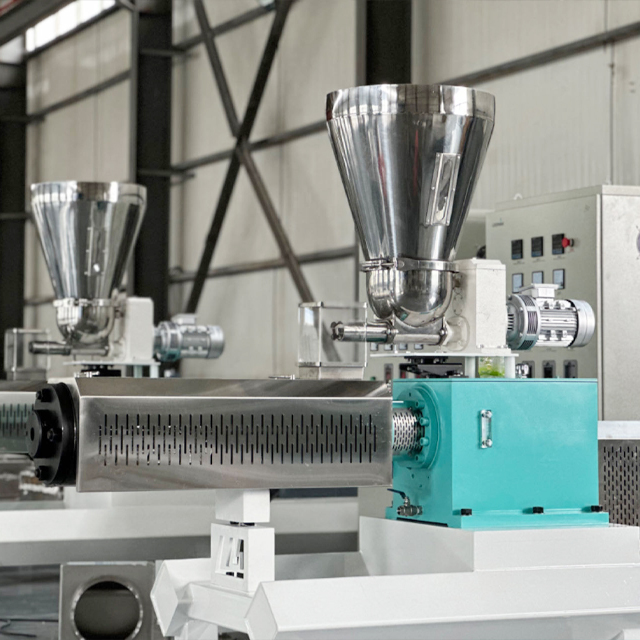
Food extrusion is an inherently abrasive process. Ingredients like whole grains, corn grits, bran fibers, and bone meal act as abrasive compounds, rapidly wearing down the internal geometry of the die orifices. Selecting the correct metallurgy is paramount. Standard 300-series stainless steel offers excellent corrosion resistance but lacks the hardness required for abrasive recipes. 400-series stainless steels, such as 420 or 440C, can be heat-treated to higher Rockwell hardness levels, providing a better balance of wear resistance and food safety.
For highly abrasive applications, engineers apply advanced surface hardening treatments. Nitriding diffuses nitrogen into the steel surface, creating a hard, wear-resistant layer. Hard chrome plating reduces friction and extends lifespan but carries risks of flaking if the underlying substrate deforms. Advanced Physical Vapor Deposition (PVD) and Diamond-Like Carbon (DLC) coatings provide extreme surface hardness and excellent release properties, preventing sticky doughs from adhering to the die lands.
Dies must comply strictly with sanitary design standards set by organizations like the FDA, USDA, and EHEDG. Bacterial harborage is a severe risk in food processing. Dies must feature smooth surface finishes, typically requiring Ra values of 0.8 µm or better. Internal geometries must eliminate sharp corners, dead ends, and crevices where food particles can become trapped and degrade.
All materials, including the base metals, coatings, and O-ring seals, must be certified food-grade. The design must facilitate thorough cleaning, ensuring that sanitizing chemicals can reach all internal surfaces and drain completely without pooling.
Temperature control at the die face directly impacts the vaporization of moisture and the final expansion index. Some processes require the die to be heated to prevent the melt from cooling and solidifying prematurely, which would cause blockages. Other processes, particularly those involving proteins or dense pellets, require cooling jackets integrated into the die assembly to remove excess heat and prevent unwanted expansion.
Advanced die designs incorporate thermocouple ports. These ports allow sensors to measure the actual temperature of the food melt just millimeters before it exits the orifice. Real-time temperature data is critical for fine-tuning the extruder's thermal profile and ensuring consistent product quality across varying ambient conditions.
Die swell is the physical expansion of the viscoelastic melt immediately upon exiting the restrictive environment of the die. As the polymer chains are compressed through the orifice, they store elastic energy. Once free of the die walls, they recoil, causing the extrudate to expand outward. If not properly managed, die swell distorts complex shapes. A star shape may swell into an unrecognizable blob.
Engineers compensate for die swell during the initial CAD design phase. The physical orifice is machined smaller and often with exaggerated angles to counteract the anticipated swelling behavior. The L/D ratio is also tuned to allow maximum relaxation of the polymer chains before exit, minimizing the severity of the swell and preventing post-extrusion product warpage.
Stagnant flow areas within the die assembly are catastrophic for product quality. In these dead zones, the food melt stops moving, overheats, and eventually carbonizes. This degraded material periodically breaks loose, contaminating the product stream with hard, black specks. Preventing dead zones requires streamlining all internal geometries.
Engineers utilize torpedoes, spiders, and gradual transition angles to guide the melt smoothly from the large barrel diameter down to the small orifices. The internal flow path must adhere to a strict first-in-first-out (FIFO) principle. Abrupt changes in diameter or sharp internal corners must be entirely eliminated to maintain continuous, sweeping fluid motion.
Operators must recognize and correct specific defects occurring directly at the die face. Sharkskinning, or melt fracture, presents as a rough, scaly surface on the extrudate. It occurs when the melt exits the die too quickly, causing the outer layer to tear. Adjusting the melt temperature, increasing the die land length, or applying a specialized surface coating can resolve this friction-induced tearing.
Surging is a rhythmic pulsing of the product flow. It often indicates a mismatch between the die's backpressure and the extruder's conveying capacity. Balancing the die open area with the screw speed stabilizes the flow. Port plugging occurs when large particulates in the recipe block individual orifices. Managing recipe grind size and incorporating inline screen packs before the die prevents these localized blockages.
Defect Type | Visual Indicator | Root Cause | Corrective Action |
|---|---|---|---|
Sharkskinning | Rough, scaly surface | Excessive exit velocity, high friction | Increase melt temperature, lengthen die land |
Surging | Pulsing flow, uneven lengths | Pressure mismatch, feed inconsistency | Adjust screw speed, verify feed rate |
Port Plugging | Missing product streams | Oversized particulates, foreign material | Install screen packs, check ingredient grind |
Die Swell Distortion | Loss of shape definition | Inadequate polymer relaxation | Increase L/D ratio, modify orifice angles |
Relying on trial and error for die manufacturing is highly inefficient. Industry leaders utilize Computational Fluid Dynamics (CFD) software to simulate the exact flow behavior of the non-Newtonian food melt. CFD models predict pressure drops, velocity profiles, and temperature gradients across the entire die assembly before any metal is cut. This simulation identifies flow imbalances and dead zones virtually.
Following CFD validation, physical prototyping and pilot-plant testing are essential. Testing a single-orifice prototype on a pilot extruder validates the assumed die swell and expansion characteristics under real-world shear and temperature conditions. This two-step validation process ensures the final multi-hole production die performs exactly as specified upon installation.
Choosing the right food extruder die is essential for achieving consistent product quality, efficient production, and long-term equipment performance. By optimizing die design, material selection, and flow distribution, manufacturers can reduce waste, improve product consistency, and maximize production efficiency.
At LOOMAK, we specialize in high-performance food extrusion equipment and customized processing solutions for manufacturers worldwide. With extensive engineering expertise and continuous innovation, we help customers improve production efficiency, optimize product quality, and achieve reliable long-term manufacturing performance.
Before investing in a new extrusion die, evaluate product requirements, material characteristics, equipment compatibility, and long-term maintenance costs to ensure the best production results.
A: Hardened stainless steels, particularly 400-series alloys like 420 or 440C, are the most common. They provide the necessary balance of food-grade corrosion resistance and the mechanical hardness required to withstand the abrasive nature of extruded grains and starches.
A: There is a direct inverse relationship. A smaller open area increases backpressure within the barrel. This higher pressure increases the motor load, elevates the melt temperature through increased friction, and subjects the food material to higher mechanical shear.
A: Single-screw dies must provide significant restriction to generate the pressure needed for mixing and cooking. Twin-screw dies can accommodate larger open areas and more complex shapes because the twin screws provide positive displacement and generate their own precise pressure profiles.
A: Die swell is caused by the viscoelastic recovery of the food melt. As starches and proteins are forced through the restrictive die orifice, their polymer chains compress. Upon exiting, they rapidly recoil and expand outward, causing the product to swell beyond the orifice dimensions.
A: Pressure drop calculations require complex rheological modeling. The primary variables include the non-Newtonian melt viscosity, the volumetric flow rate, the specific internal geometry of the approach channels, and the land length of the final orifices.
A: Cross-utilization is highly limited. Different recipes possess unique rheologies, moisture contents, and expansion requirements. A die optimized for a high-starch puffed snack will fail to produce the correct texture or density for a high-protein, low-expansion product.
A: Replacement cycles depend entirely on recipe abrasiveness and operating hours. Dies processing high-fiber or whole-grain recipes may require refurbishment every few months. Operators should replace or re-machine dies as soon as visible degradation affects product dimensional tolerances or piece weight consistency.


