Views: 0 Author: Site Editor Publish Time: 2026-07-22 Origin: Site
Out-of-spec products, material waste, and unplanned downtime compound rapidly in continuous manufacturing operations. When processing parameters drift, the financial impact hits the bottom line immediately. Operators face a complex challenge when isolating variables on the plant floor. Minor fluctuations in thermal energy, mechanical shear, or feed moisture drastically alter product viability. These shifts change the texture, structural integrity, and nutritional profile of the final output.
Mastering food extrusion troubleshooting requires a systematic framework for diagnosing root causes. You cannot rely on reactive guesswork. Instead, you must optimize equipment parameters and evaluate process upgrades based on hard data. This guide provides actionable steps to stabilize your production line. We will explore how to isolate thermodynamic variables, calibrate moisture levels, and leverage hardware configurations to achieve consistent, defect-free production.
Effective defect reduction requires isolating and balancing the three primary energy sources: thermal (barrel heating), mechanical (shear), and moisture-driven rheological changes.
Surface defects and expansion inconsistencies are most frequently resolved through strict barrel temperature profiling and precise feed moisture calibration.
Optimizing screw extruder configurations and die designs provides a structural defense against nutrient degradation, dimensional variation, and textural failure.
Sustainable quality control demands shifting from reactive adjustments to automated, sensor-driven monitoring of Specific Mechanical Energy (SME) and melt pressure.
Table of Contents
Defining a defect requires strict success criteria based on the target product profile. In continuous processing, a defect is any deviation from acceptable bulk density targets, hardness metrics, visual uniformity, or nutritional baseline. When extrudates fail to meet these specifications, you lose raw material and operational time. The cost of running out-of-spec product scales exponentially as downstream packaging and coating systems jam or reject the deformed output.
Operators often push throughput limits to maximize yield. This trade-off exponentially increases defect rates if parameter control lags behind feed rates. Pushing more mass through a fixed die area alters the residence time and pressure dynamics. The system loses its delicate balance. You must maintain strict control over the mass flow rate to prevent surging and uneven cooking. When you increase the feed rate without adjusting screw speed or thermal inputs, the specific mechanical energy drops. This leaves the core of the product undercooked and dense.
Poor process control introduces severe compliance, safety, and nutritional risks. Undercooking leaves harmful microbial loads intact. It also allows anti-nutritional factors like trypsin inhibitors and phytates to survive, which severely impacts the digestibility of soy and pulse-based products. Conversely, overcooking triggers acrylamide formation. It degrades starches and destroys heat-sensitive vitamins and proteins. You face a delicate balancing act. You must apply enough energy to denature harmful enzymes while preserving the essential nutritional matrix of the food.
To establish a baseline for defect identification, plant managers should categorize failures into specific operational buckets. This prevents operators from chasing symptoms rather than addressing the root mechanical or thermodynamic failure.
Dimensional failures: The product expands too much or too little, failing to fit into standard packaging volumes.
Textural failures: The extrudate lacks the required crispness, resulting in a chewy or glass-like structure.
Aesthetic failures: Surface tearing, discoloration, or uneven cutting lengths ruin the consumer appeal.
Nutritional failures: Laboratory testing reveals degraded protein structures or destroyed vitamin additives.
A systematic approach separates defects into three categories: formulation-based, process-based, or equipment-based. Before turning dials on the control panel, you must identify which category drives the failure. This prevents compounding errors where operators adjust the wrong variable to fix a symptom rather than the root cause. If the moisture content of your raw cornmeal fluctuates in the silo, adjusting the barrel temperature only masks the underlying formulation inconsistency.
The process relies on the interplay between external barrel heating and internal friction. Thermal energy comes from the jacketed barrel heaters. Mechanical energy generates from the internal friction of the rotating elements pushing viscous dough against the stationary barrel walls. You must isolate these two sources to control the melt temperature accurately. If a product is burning, you need to know if the barrel heaters are set too high or if the internal shear is generating excessive friction heat.
Establishing baselines for Specific Mechanical Energy (SME) is mandatory for repeatable quality. SME quantifies the amount of mechanical work transferred into the dough. It has a direct correlation to product expansion and cell structure. High SME typically increases starch gelatinization, leading to greater expansion. If SME drops unexpectedly, you will likely see dense, undercooked extrudates. Monitor motor load and screw speed to calculate and track SME continuously. You can calculate SME by dividing the motor power applied to the material by the total mass flow rate.
Energy Source | Primary Driver | Impact on Product | Control Mechanism |
|---|---|---|---|
Thermal Energy | Barrel heaters and cooling jackets | Initiates starch gelatinization; controls surface temperature. | PID temperature controllers; zone set-points. |
Mechanical Energy (Shear) | Screw profile and motor RPM | Dictates internal melt viscosity; drives expansion dynamics. | Screw speed adjustments; modifying kneading blocks. |
Moisture acts as the primary plasticizer in the barrel. Low feed moisture combined with high barrel temperatures significantly increases melt viscosity. The material becomes thick and resists flow. This high viscosity generates massive internal friction, spiking the mechanical shear. When processing high-protein formulations, this lack of lubrication can cause the extruder to over-torque and shut down.
Finding the optimization sweet spot requires precise calibration. Adjusting low feed moisture alongside high barrel temperatures minimizes bulk density and hardness. This combination maximizes the expansion ratio of starch-based extrudates. The sudden pressure drop at the die causes the superheated water to flash off as steam, puffing the product. If the moisture is too high, the steam flash is weak, and the product collapses into a dense pellet.
The relationship between moisture levels and plasticization dictates the final texture. Higher moisture levels lubricate the melt. This reduces friction, lowers SME, and results in a denser, harder extrudate with less expansion. You must lock in your moisture targets at the pre-conditioner to maintain rheological stability. Operators should take manual moisture samples from the pre-conditioner discharge every hour to verify the automated flow meters are functioning correctly.
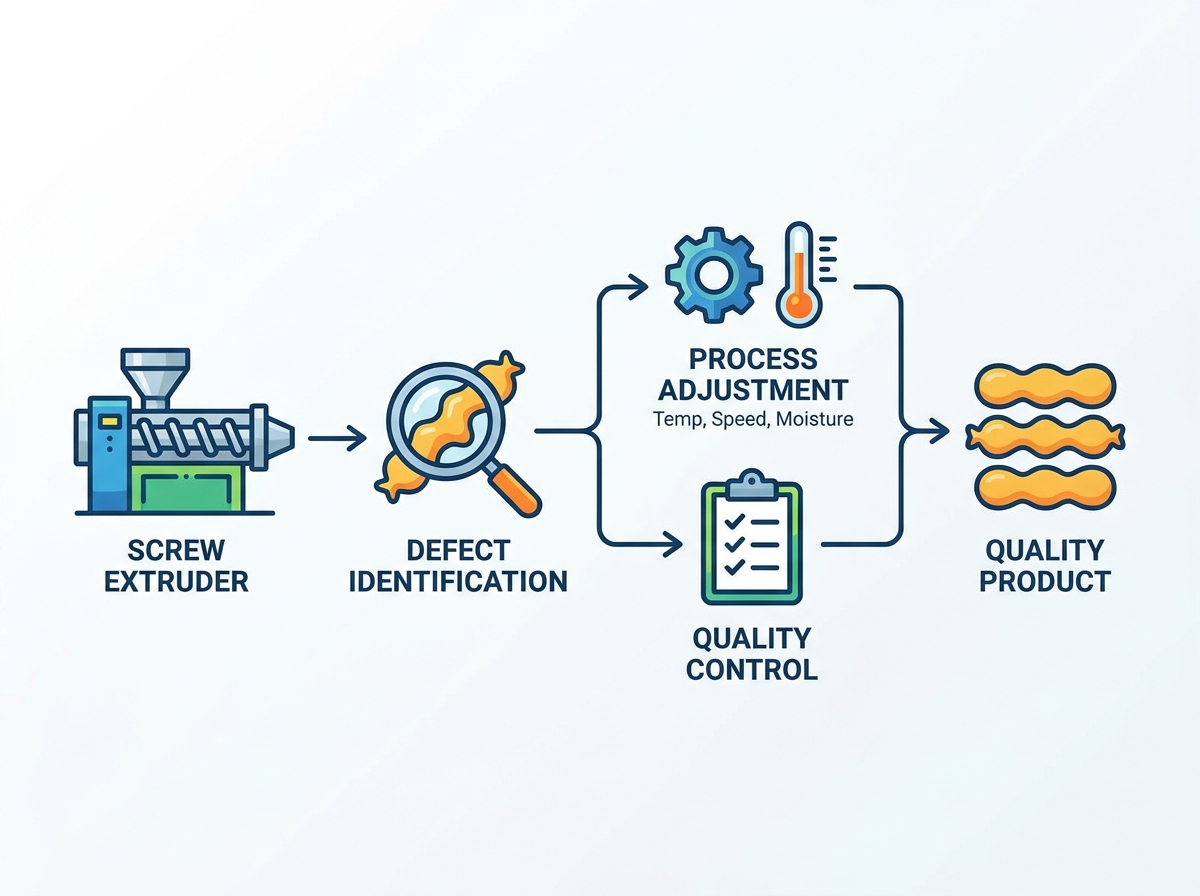
Mapping specific visual and structural defects to their mechanical or thermodynamic causes speeds up recovery time. You must evaluate features against outcomes. Every physical flaw points back to a specific parameter deviation. When you understand the physics of the melt, troubleshooting becomes a logical deduction rather than a guessing game.
When the product is too dense, too fragile, or exhibits uneven puffing, the expansion dynamics are failing. These symptoms ruin mouthfeel and packaging fill weights. A bag of snacks that is too dense will look half-empty, leading to consumer complaints. A product that is too fragile will turn to dust during transit.
Audit the die temperature to ensure it remains stable during the run. A cold die restricts flow and increases density.
Check for moisture surging in the pre-conditioner. Inconsistent water injection creates pockets of wet and dry dough.
Verify screw speed stability to prevent flow rate fluctuations. A surging motor indicates material bridging in the feed throat.
Analyze dimensional variation caused by die swell. This is the elastic recovery of the starch or protein melt as it exits the die. High die swell requires a longer die land to stabilize the flow.
Inspect the knife assembly. A dull blade can crush the extrudate before it fully expands, artificially increasing the bulk density.
Rough textures, surface fracturing, or localized burning indicate severe rheological stress at the discharge point. Sharkskin tearing happens when the melt fractures under high shear stress as it exits the die. The outer layer of the extrudate moves slower than the inner core due to friction against the die wall, causing the surface to rip.
Address temperature fluctuations at the die head immediately. Increasing the die temperature slightly can lubricate the flow and stop surface tearing.
Evaluate polymer and starch melt uniformity across the barrel. Unmelted particles act as stress concentrators, initiating tears.
Inspect the die land length for excessive pressure drops. A land length that is too short does not give the melt enough time to align its polymer chains.
Implement tight temperature control to prevent viscosity variations at the discharge.
Check for localized burning caused by dead zones in the die assembly where material stagnates and degrades over time.
Loss of heat-sensitive vitamins, poor protein texturization, or undesirable mouthfeel point to severe over-processing. High levels of active anti-nutritional factors point to under-processing. You must balance the thermal input to achieve a complete cook without scorching the matrix.
Reduce residence time by adjusting the feed rate or increasing the screw speed. Faster transit times protect heat-sensitive ingredients.
Lower peak shear zones by modifying the internal element profile. Swap out aggressive kneading blocks for forwarding elements.
Optimize moisture to balance shear and thermal cooking. Adding slightly more water reduces friction heat and protects proteins from denaturing too rapidly.
Evaluate the cooling profile in the final barrel sections. You must stop the cooking reaction before the material reaches the die plate.

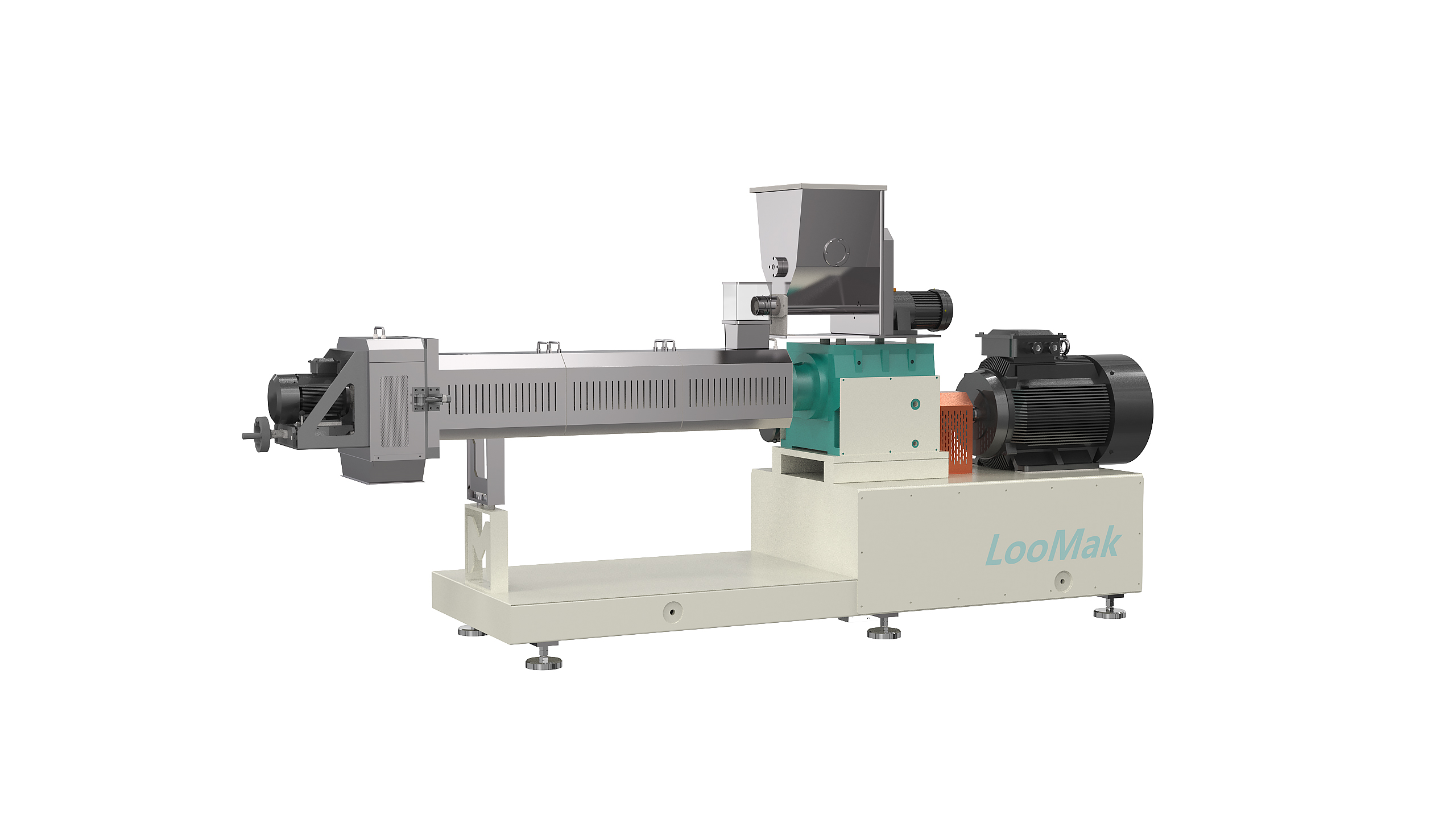
Hardware configurations dictate process stability. You must assess how your current setup limits defect opportunities. A well-configured screw extruder provides a robust defense against process drift. The internal geometry of the machine is just as important as the recipe you feed into it.
The internal profile design directly impacts mixing efficiency and shear generation. Forwarding elements convey material down the barrel. Kneading blocks mix and shear the dough, breaking down particle sizes. Reversing elements create pressure locks, forcing the barrel to fill completely and increasing the residence time. You must analyze the impact of this geometry on your specific formulation. A profile designed for heavy pet food will destroy a light, expanded snack formulation.
Evaluate the trade-offs between single and twin configurations. Twin systems offer superior ingredient flexibility. Their intermeshing design provides self-wiping capabilities. This prevents material stagnation, localized burning, and inconsistent flow. The flights of one shaft constantly clean the root of the other shaft. Single systems cost less but struggle with sticky, high-moisture, or high-fat formulations because they rely entirely on wall friction to convey the material forward.
Element Type | Primary Function | Impact on Melt Pressure |
|---|---|---|
Forwarding Pitch | Conveys material toward the die. | Lowers pressure; empties the barrel zone. |
Kneading Blocks | Applies high shear and dispersive mixing. | Neutral to moderate pressure increase. |
Reversing Pitch | Pushes material backward to create a seal. | Massive pressure spike; ensures 100% fill. |
Multi-zone temperature control ensures the material melts, cooks, and cools at precise stages. You cannot apply uniform heat across the entire barrel. Each zone serves a specific thermodynamic purpose. The feed zone must remain cool to prevent premature gelatinization, which causes bridging and blocks the inlet. The compression zone requires moderate heat to begin plasticization. The metering zone requires precise control to finalize the melt viscosity before discharge.
Establish a minimum critical temperature protocol. Tune barrel temperatures to the lowest effective set-point required for complete starch gelatinization and protein cook. This prevents thermal runaway and product discoloration. Advanced PID controllers and jacketed cooling systems mitigate thermal runaway by rapidly removing excess friction heat generated by the rotating elements. If the internal shear generates more heat than the process requires, the cooling jackets must flood with chilled water instantly to stabilize the zone.
Die restriction influences upstream fill length and melt pressure. A highly restricted die forces material to back up into the barrel. This increases residence time and mechanical shear. You must match the open area of the die to your target throughput. If you push 1,000 kilograms per hour through a die designed for 500 kilograms, the pressure will spike, the motor will over-torque, and the product will scorch.
Uniform flow distribution in multi-hole dies prevents product variation. If flow favors the center holes, extrudates will cut at different lengths. Dimensional inconsistencies across the cutting face ruin packaging efficiency. Design the die plate to balance pressure drops equally across all discharge points. This often requires internal flow channels or breaker plates to distribute the melt evenly before it reaches the final orifices.

Deciding when to tweak existing standard operating procedures versus investing in new hardware requires a clear framework. You must evaluate the overall value and influencing factors of your current setup. Sometimes, a simple change in feed moisture solves the problem. Other times, the physical machinery is too degraded to maintain control.
Mechanical obsolescence destroys process control. Look for indicators like excessive wear leading to blowback. When material flows backward over the flights, you lose pressure control. This causes surging and inconsistent product dimensions. You can measure this wear by pulling the shafts and checking the clearance between the flight tips and the barrel wall. If the clearance exceeds the manufacturer's tolerance, no amount of parameter adjustment will fix the surging.
Calculate the return on investment for upgrading metallurgy. Wear-resistant alloys maintain tight tolerances over time. Abrasive ingredients like high-fiber brans, calcium carbonate, or silica degrade standard steel quickly. Upgrading the metallurgy to high-chromium or tungsten-carbide coated elements reduces downtime and extends the lifespan of your internal components. The upfront cost is higher, but the reduction in out-of-spec product pays for the upgrade rapidly.
Modern processing requires data. Evaluate the integration of inline rheometers and continuous moisture sensors. Automated feedback loops adjust water injection rates instantly based on real-time readings. If the raw material moisture drops by 1%, the system automatically increases the pre-conditioner water flow to compensate, keeping the melt viscosity perfectly stable.
Data-logging prevents operator-induced variability. It standardizes batch-to-batch quality. When the system records SME, pressure, and temperature continuously, you can trace defects back to the exact second the process drifted. This eliminates guesswork during post-mortem quality audits. You can overlay the data from a good run against a bad run and immediately spot the diverging parameter.
Rolling out new troubleshooting protocols or equipment changes introduces risks on the plant floor. You must manage these transitions carefully to avoid disrupting current production schedules. A poorly executed upgrade can cause more downtime than the original defect.
Tribal knowledge poses a massive risk to quality assurance. When operators make undocumented, intuitive adjustments, the process becomes unrepeatable. One shift might run the machine differently than the next, resulting in a product that looks and tastes different depending on who is working.
Develop strict, data-driven Standard Operating Procedures. Base these SOPs on SME and pressure targets rather than arbitrary speed settings. Train your team to understand the rheological reasons behind the set-points. When operators understand the physics of the melt, they make better decisions. They stop treating the control panel like a video game and start treating it like a scientific instrument.
Introducing new ingredients alters melt behavior. High-fiber or high-protein inclusions accelerate wear and induce new defects. They change the water-binding capacity of the dough, which throws off your established moisture targets. Pea protein, for example, requires significantly more mechanical shear to texturize than soy protein.
Mitigate this risk through pilot-scale testing protocols. Never roll out a major formulation change directly to full-scale production. Test the rheology, measure the required SME, and inspect the die swell on a lab-scale unit first. This protects your main production line from unexpected downtime and massive raw material waste.
Effective food extrusion troubleshooting is essential for maintaining consistent product quality, reducing production waste, and maximizing equipment performance. By combining optimized process parameters with advanced monitoring and preventive maintenance, manufacturers can achieve more stable and efficient production.
At LOOMAK, we specialize in advanced food extrusion equipment and customized processing solutions for global manufacturers. Our experienced engineering team helps customers optimize production processes, improve product quality, and increase long-term operational efficiency through reliable equipment and technical support.
Before making major process adjustments or equipment upgrades, evaluate product formulation, extrusion parameters, equipment condition, and process data to identify the true root cause and achieve the best production results.
A: Poor expansion typically results from high feed moisture, low barrel temperature, or insufficient mechanical shear. High moisture lubricates the melt, reducing the friction needed to generate optimal Specific Mechanical Energy (SME). Without enough heat and shear, the starch fails to gelatinize fully, preventing the sudden steam flash-off required for puffing at the die.
A: Feed moisture has an inverse relationship with expansion and crispness. Lower moisture, when paired with optimized high barrel temperatures, increases melt viscosity and shear. This minimizes product hardness and maximizes the expansion ratio, creating a lighter, crispier texture. High moisture creates a denser, harder product.
A: Inconsistent shapes stem from die pressure fluctuations, uneven feed rates, or worn internal elements. When flights wear down, material blows back, causing surging. Additionally, variations in die swell—the elastic expansion of the melt as it exits—can warp shapes if temperature and moisture are not strictly controlled.
A: Prevent sharkskin by implementing precise temperature control at the die head. Tearing occurs when the melt viscosity is too high or uneven as it exits, causing the surface to fracture under shear stress. Increasing die temperature slightly and ensuring uniform polymer flow reduces this localized stress.
A: SME is the primary metric for quantifying the amount of mechanical work and shear transferred from the motor into the product. It matters because it directly dictates the cook level, starch gelatinization, and final texture. Monitoring SME helps operators maintain consistent quality and detect process drift immediately.
A: Minimize nutrient loss by reducing the residence time inside the barrel. Optimize feed moisture to lower internal friction and avoid excessive peak shear zones. Additionally, utilize jacketed cooling zones in the final barrel sections to stop the thermal cooking reaction before the product exits the die.
A: You must optimize the balance between thermal energy and residence time. Set the barrel temperature just high enough to denature heat-sensitive anti-nutrients, like trypsin inhibitors, but keep the residence time short. This precise thermodynamic control ensures harmful enzymes are destroyed without severely degrading essential vitamins and proteins.


