Views: 0 Author: Site Editor Publish Time: 2026-08-05 Origin: Site
Consumer demand for better-for-you snacks introduces complex functional ingredients into extrusion matrices. This shift disrupts traditional expansion dynamics and sensory profiles. Achieving consistent radial expansion and the desired extruded snack texture is increasingly difficult when incorporating high-protein or high-fiber formulations. Manufacturers face costly trial-and-error cycles dealing with high bulk density, die stickiness, and collapsed cell structures. Systematically improving these physical characteristics requires a dual approach. You must precisely manipulate extrudate composition while maintaining rigorous control over thermomechanical process parameters. We will look at specific moisture targets, screw configurations, and die designs that directly impact the final product. This guide breaks down the technical levers necessary to engineer and scale optimal texture profiles.
Moisture and Starch are Foundational: Precise moisture control and specific amylose-to-amylopectin ratios dictate the melt viscosity and glass transition necessary for optimal radial expansion.
Functional Ingredients Require Mitigation: Increasing protein or fiber content inherently reduces expansion and increases density; counteracting this requires specialized modified starches or adjusted shear profiles.
Process Parameters Drive Final Phenotypes: Specific Mechanical Energy (SME), driven by screw speed and barrel temperature, directly dictates the cellular structure and resulting crispness or crunchiness.
Scalability Demands Process Tolerance: Selecting ingredients with high process tolerance prevents texture degradation during continuous, commercial-scale extrusion runs.
Table of Contents
Establishing quantifiable metrics for texture is mandatory before initiating R&D trials. This ensures alignment between sensory targets and manufacturing capabilities. Without clear benchmarks, adjusting formulations becomes a guessing game on the production floor. You need specific parameters to evaluate how changes in moisture or shear affect the final product. Operators must know exactly what physical properties define a pass or fail for a given production run. Relying on subjective evaluations leads to inconsistent batches and high rejection rates.
When setting up a new product profile, the R&D team must define the target moisture out of the extruder, the target bulk density, and the required shear force to break the product. These metrics provide a baseline. If a new high-fiber formulation causes the bulk density to double, the team immediately knows they must adjust the specific mechanical energy or the feed moisture to compensate. Quantifiable data removes the emotion from product development and focuses efforts on mechanical and chemical adjustments.
The Sectional Expansion Index (SEI) serves as a primary metric for evaluating extrudate quality. SEI correlates directly to perceived lightness in the mouth. You calculate SEI by dividing the cross-sectional area of the extrudate by the cross-sectional area of the die opening. Higher SEI values typically indicate a highly expanded, airy matrix. For a standard corn puff, you might target an SEI between 15 and 20. For a denser, crunchier product, an SEI of 5 to 10 is more appropriate.
You must also establish acceptable bulk density ranges. Bulk density dictates packaging requirements and portion control. A product might expand beautifully but fail if it does not fit standard packaging volumes. We measure bulk density by weighing a known volume of the extrudate, typically expressed in grams per liter (g/L). A standard cheese puff might sit around 40 to 60 g/L, while a high-protein pea snack might range from 100 to 150 g/L. Controlling bulk density ensures that a 50-gram serving fills the bag to the correct level, preventing consumer complaints about underfilled packages.
Differentiating structural requirements helps map physical properties to consumer expectations. Crispness requires thin cell walls and high acoustic emission upon fracturing. When a consumer bites into a crisp snack, the cell walls shatter rapidly, creating a high-frequency sound. Crunchiness demands thicker cell walls and a higher fracture force. The sound is lower in frequency, and the product requires sustained chewing to break down completely.
Alternative profiles, such as cohesive or chewy textures found in third-generation pellets or pet treats, require entirely different matrix structures compared to traditional crisp matrices. These products rely on incomplete starch gelatinization or the addition of humectants to retain moisture and flexibility. Understanding the target phenotype dictates the entire extrusion strategy, from raw material selection to die design.
Texture Phenotype | Cell Wall Structure | Fracture Force | Acoustic Emission | Target SEI |
|---|---|---|---|---|
Crispness | Thin, highly expanded | Low | High frequency, sharp | 15 - 25 |
Crunchiness | Thick, dense | High | Low frequency, sustained | 5 - 12 |
Chewiness | Cohesive, minimal expansion | Variable (elastic) | Minimal to none | 1 - 3 |
Mapping instrumental texture analysis to human sensory panels bridges the gap between raw data and consumer experience. Tools like the Kramer shear cell or texture profile analysis provide objective measurements of hardness, fracturability, and springiness. You can correlate these instrumental readings with sensory panel feedback to standardize production targets. If a sensory panel identifies a product as too hard, you check the Kramer shear cell data. If the force required to shear the product exceeds your established upper limit, you know you need to increase expansion or reduce cell wall thickness.
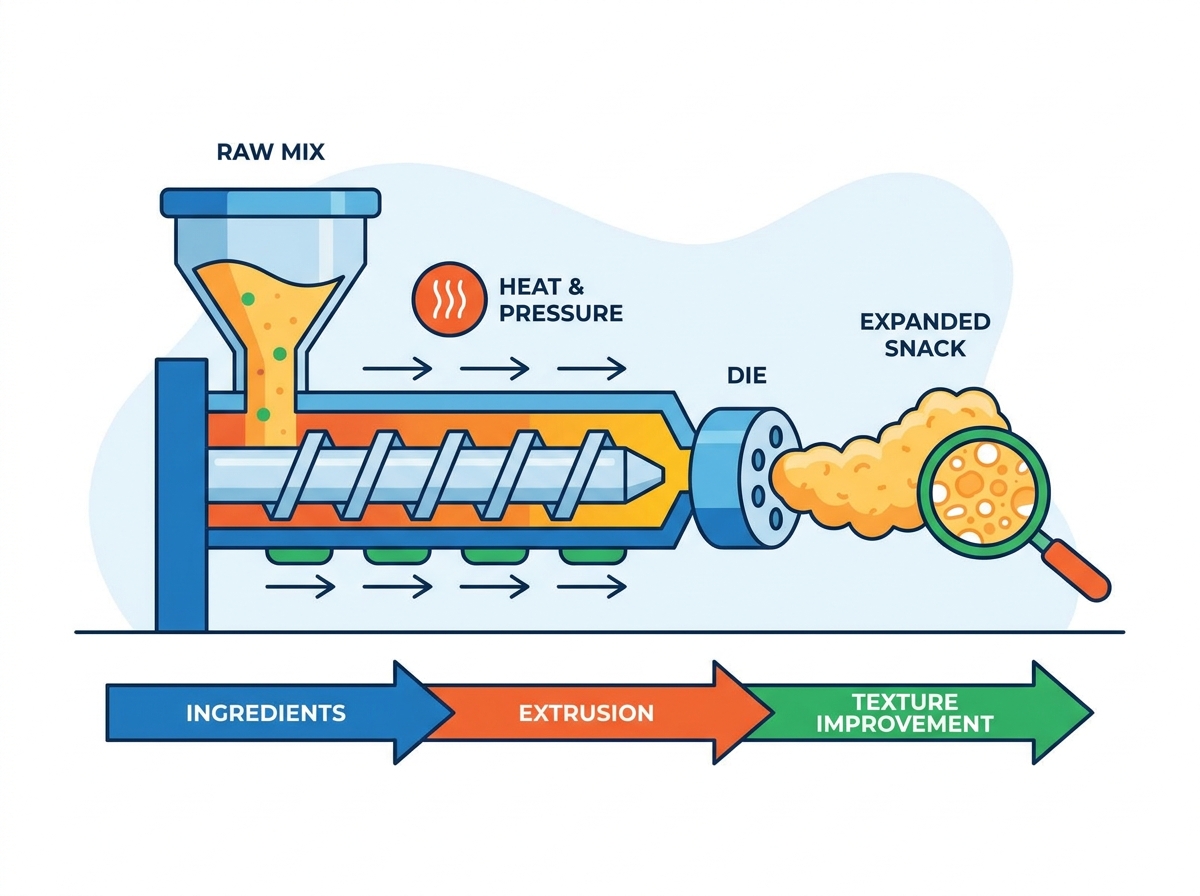
Evaluating how base matrix components interact under high heat and pressure is essential. These interactions dictate the final extruded snack texture. Ingredient selection forms the foundation of your expansion strategy. You cannot force a poorly formulated mix to expand properly, regardless of how much mechanical energy you apply.
Feed moisture acts as a crucial plasticizer inside the extruder barrel. It lowers melt viscosity, allowing the dough to flow and mix properly. Water molecules insert themselves between starch chains, increasing free volume and allowing the chains to move past one another. This plasticization is necessary for starch gelatinization and protein denaturation. Without adequate moisture, the material remains a dry powder and will simply burn under the high shear forces of the extruder.
A critical threshold exists for moisture levels. Too little moisture causes excessive shear, leading to matrix degradation, high barrel wear, and scorching. The product exits the die dark, hard, and unexpanded. Too much moisture limits the vapor pressure at the die. When the melt exits the die, the sudden drop in pressure causes the superheated water to flash off as steam, expanding the starch matrix. If the moisture is too high, the melt viscosity is too low to hold the expanding gas bubbles. The bubbles collapse, resulting in poor expansion and a dense, hard product. Optimal moisture for direct expanded snacks typically falls between 12% and 18%.
Starch composition heavily influences expansion dynamics. Starches consist of two main polymers: amylose (linear) and amylopectin (highly branched). Amylopectin promotes high expansion and a light, airy texture. Its branched structure traps steam effectively during the flash-off phase. Waxy corn or waxy rice starches, which are nearly 100% amylopectin, produce extremely light and fragile puffs.
Amylose provides structural integrity and contributes to crunchiness. Its linear chains align and form strong films, creating thicker, more resilient cell walls. High-amylose starches restrict expansion but improve the crunch and bowl-life of the product. Balancing these two components is vital for hitting specific sensory targets. A typical corn meal used for standard puffs contains about 25% amylose and 75% amylopectin.
Assessing the value of pre-gelatinized versus native starches in the feed mix also impacts processing. Pre-gelatinized starches absorb water rapidly at room temperature, altering the initial viscosity profile in the barrel. They can help bind water in formulations with high levels of non-starchy ingredients, but excessive use can lead to premature viscosity buildup and surging in the extruder.
Understanding the mechanism of texture degradation is necessary when formulating healthier snacks. Insoluble fibers, such as okara, bran, or legume fibers, act as physical inert fillers. They do not melt or participate in the continuous starch matrix. Instead, they physically rupture gas cells during expansion. As the steam tries to expand the bubble, the sharp edges of the fiber particles puncture the cell wall, allowing the gas to escape. This leads to a dense, unexpanded product.
Proteins present a different challenge. Under heat and shear, proteins denature and cross-link, forming rigid, elastic networks. These networks restrict radial expansion. The protein matrix acts like a rubber band, pulling the expanding starch matrix back in on itself. Additionally, proteins compete with starch for available water, altering the gelatinization profile.
Analyze the base formulation to determine the total percentage of non-starchy functional ingredients.
Select a highly functional, high-amylopectin starch to serve as the primary expansion driver.
Mill insoluble fibers to the finest possible particle size to minimize cell wall rupture.
Adjust feed moisture slightly higher to compensate for the water-binding capacity of added proteins.
Increase specific mechanical energy to ensure complete mixing and dispersion of the functional ingredients within the starch matrix.
Analyzing case study thresholds reveals the extent of this impact. Increasing okara levels up to 50% linearly reduces radial expansion. This addition increases density and significantly alters cell-wall thickness. Formulation adjustments are mandatory to maintain crispness perception when enriching snacks to 20% protein or higher. You must compensate for the structural interference caused by these functional ingredients by optimizing the starch base and adjusting process parameters.
Deploying lipids at low levels (0.5% to 2%) acts as a mechanical lubricant. This reduces specific mechanical energy and addresses die stickiness. Oil coats the metal surfaces of the extruder barrel and screws, reducing friction. This lowers the overall temperature and shear applied to the melt. While this helps prevent burning and stickiness, too much oil will severely depress expansion by lubricating the starch chains too much, preventing them from holding the expanding steam.
Selecting highly process-tolerant starches helps maintain structural integrity. Cross-linked or hydroxypropylated starches withstand extreme shear forces without complete molecular degradation. Standard native starches can shear down into dextrins under high RPMs, resulting in a sticky, sweet-tasting product with poor structure. Modified ingredients stabilize the melt, ensuring consistent expansion even in challenging formulations containing high levels of protein or fiber.

Manipulating physical forces within the extruder barrel alters the extrudate melt. Equipment adjustments provide real-time control over the final product structure. You can change the texture of a product entirely without altering the recipe, simply by changing how the extruder handles the material.
Zonal temperature strategies ensure complete starch gelatinization and protein denaturation prior to the die. Extruders typically have multiple temperature zones along the barrel. You must carefully balance heat input across these zones. A standard profile for a direct expanded snack might start cool at the feed zone (e.g., 30°C) to prevent premature swelling and bridging. The temperature gradually increases through the mixing and kneading zones (e.g., 80°C to 120°C) to melt the starch. The final zone before the die is often the hottest (e.g., 140°C to 160°C) to ensure maximum vapor pressure.
Proper profiling prevents premature moisture flashing. If the temperature is too high too early in the barrel, the water turns to steam before the starch has fully melted into a continuous dough. This steam escapes back through the feed port, leaving the melt dry and prone to scorching. Gradual temperature increases typically yield the most stable melt viscosity and the most consistent expansion at the die.
Evaluating the impact of screw speed (RPM) on Specific Mechanical Energy (SME) is critical. SME represents the amount of mechanical work applied to the dough per unit of mass. It directly correlates to the shear forces applied to the melt. Higher screw speeds generally increase SME, leading to greater starch degradation, lower melt viscosity, and higher expansion. However, excessive SME can destroy the starch molecules entirely, resulting in a sticky, collapsed product.
Adjusting screw profiles modifies this energy input. Twin-screw extruders allow operators to build custom screw configurations using different elements. Forward conveying elements simply move the material. Kneading blocks and reverse pitch elements restrict flow, increasing fill level, mixing, and shear. Adding these restrictive elements increases SME. This is particularly useful for breaking down denser functional ingredients and ensuring a homogeneous melt. If a high-protein formulation is exiting the die with unmixed specks of protein isolate, adding a kneading block can resolve the issue.
Die hole geometry, specifically the length-to-diameter (L/D) ratio, influences pressure drop. The die restricts the flow of the melt, building pressure inside the extruder barrel. This pressure keeps the superheated water in a liquid state. When the melt exits the die, the sudden drop to atmospheric pressure drives vapor flash-off, which creates cellular expansion. A higher L/D ratio creates more resistance, higher pressure, and a more aligned starch structure, often resulting in a denser, crunchier product. A lower L/D ratio allows for rapid, explosive expansion, creating a lighter, crispier texture.
Managing die temperature controls the glass transition phase as the product exits. As the water flashes off, the temperature of the extrudate drops rapidly. The starch matrix transitions from a rubbery melt to a glassy, solid state. Proper temperature management locks in the expanded cellular structure before it can collapse. If the die is too hot, the matrix remains rubbery for too long, and the bubbles shrink before the structure sets.
Evaluating complex or non-standard die shapes reveals how geometry alters shear stress distribution. Shapes like stars, hollow tubes, or multi-feed co-extrusions affect radial versus longitudinal expansion. The melt flows faster through the center of a die opening than at the edges due to friction. In complex shapes, this creates localized density differences, impacting the overall bite and mouthfeel. A star shape, for example, will have denser, crunchier points and a lighter, more expanded center.
Balancing market demands with manufacturing realities requires strategic compromises. You cannot always achieve maximum expansion while maximizing nutritional content. Physics and chemistry dictate the limits of what an extruder can produce. Understanding these limits allows R&D teams to set realistic expectations for new product development.
An inverse relationship exists between nutritional enrichment and radial expansion. High fiber or protein levels naturally suppress the puffing mechanism. You need a clear decision framework. Sometimes, accepting a denser, crunchier phenotype makes sense for health-focused products. Consumers purchasing a snack with 15 grams of plant protein expect a different texture than they do from a standard cheese puff. They are often willing to accept a harder bite in exchange for the nutritional benefit.
Other times, prioritizing maximum crispness for traditional snacks takes precedence over nutritional claims. If the goal is to replicate a classic, highly expanded corn snack, you must keep protein and fiber levels low. Attempting to force a high-protein formulation to mimic a pure starch puff usually results in a product that fails on both fronts: it lacks the desired texture and causes massive processing headaches.
Weighing the cost of premium modified starches is a necessary exercise. These ingredients cost more upfront but often reduce waste and improve continuous run times. A cheap native starch might work in a lab setting for a 10-minute run. However, on a commercial line running 24/7, that same starch might shear down inconsistently, causing the product to drift out of specification and leading to hours of downtime and thousands of pounds of scrap.
Assessing the return on investment for upgrading extruder screw configurations is also important. Relying solely on formulation tweaks might not be enough for complex matrices. Equipment upgrades can provide the mechanical flexibility needed to process difficult ingredients efficiently. Purchasing a new set of kneading blocks or a specialized die plate might cost a few thousand dollars, but if it allows you to run a high-margin functional snack consistently, the payback period is incredibly short.
Actionable fixes for standard production issues keep manufacturing lines running smoothly. Identifying the root cause quickly minimizes downtime and product waste. Operators must understand how to read the extruder's feedback—motor load, die pressure, melt temperature—and correlate that data to the physical product exiting the die.
Symptom | Probable Cause | Immediate Action |
|---|---|---|
Die Stickiness | Excessive SME, low moisture | Increase feed moisture by 1%, reduce screw RPM |
Hard, Dense Product | Low SME, high moisture, high fiber | Decrease feed moisture, increase screw RPM |
Surging / Inconsistent Shape | Uneven feed rate, poor hydration | Check feeder calibration, increase pre-conditioner residence time |
Scorched / Dark Product | Barrel temps too high, low moisture | Lower zone 3/4 temperatures, verify water injection rate |
Diagnosis usually points to insufficient moisture, excessive starch degradation, or a lack of lubrication. When starch is over-sheared, it breaks down into sticky dextrins that adhere to the metal die face. The product clumps together as it is cut, forming large, unusable masses. Mitigation involves lowering moisture slightly while introducing low-level lipids. You can also adjust the feed rate or lower barrel temperatures in the final zone. These adjustments help preserve starch integrity and prevent the melt from adhering to the die face.
Diagnosis often reveals low SME, high moisture, or excessive fiber disrupting bubble formation. If the extruder is not imparting enough mechanical energy, the starch does not melt completely, and the product fails to expand. Mitigation requires increasing screw speed to boost mechanical energy. Reducing feed moisture can also increase vapor pressure at the die, driving more aggressive expansion. Utilizing finer particle sizes for fiber inclusions minimizes cell wall rupture. Introducing high-process-tolerance starches can further stabilize the expanding matrix.
Diagnosis typically uncovers surging in the extruder, inconsistent feed rates, or uneven moisture distribution. Surging occurs when the extruder is not completely full, causing the material to move through the barrel in waves rather than a steady flow. This results in pressure fluctuations at the die, causing the product to alternate between highly expanded and dense. Mitigation starts with implementing pre-conditioning steps to hydrate the mix uniformly before it enters the barrel. Stabilizing the volumetric or gravimetric feeder ensures a consistent mass flow rate. Ensuring uniform particle size in the dry mix prevents localized variations in melt viscosity.
Initiate pilot-scale trials focusing on isolating one variable at a time, beginning with feed moisture and screw speed to establish a baseline.
Adjust barrel temperature profiles to optimize starch gelatinization without causing premature flashing in the early zones.
Utilize instrumental texture analysis to benchmark expansion and fracture force against target prototypes to remove subjective evaluation.
Audit dry mix particle size to ensure uniform hydration and stable extruder feed rates during continuous production.
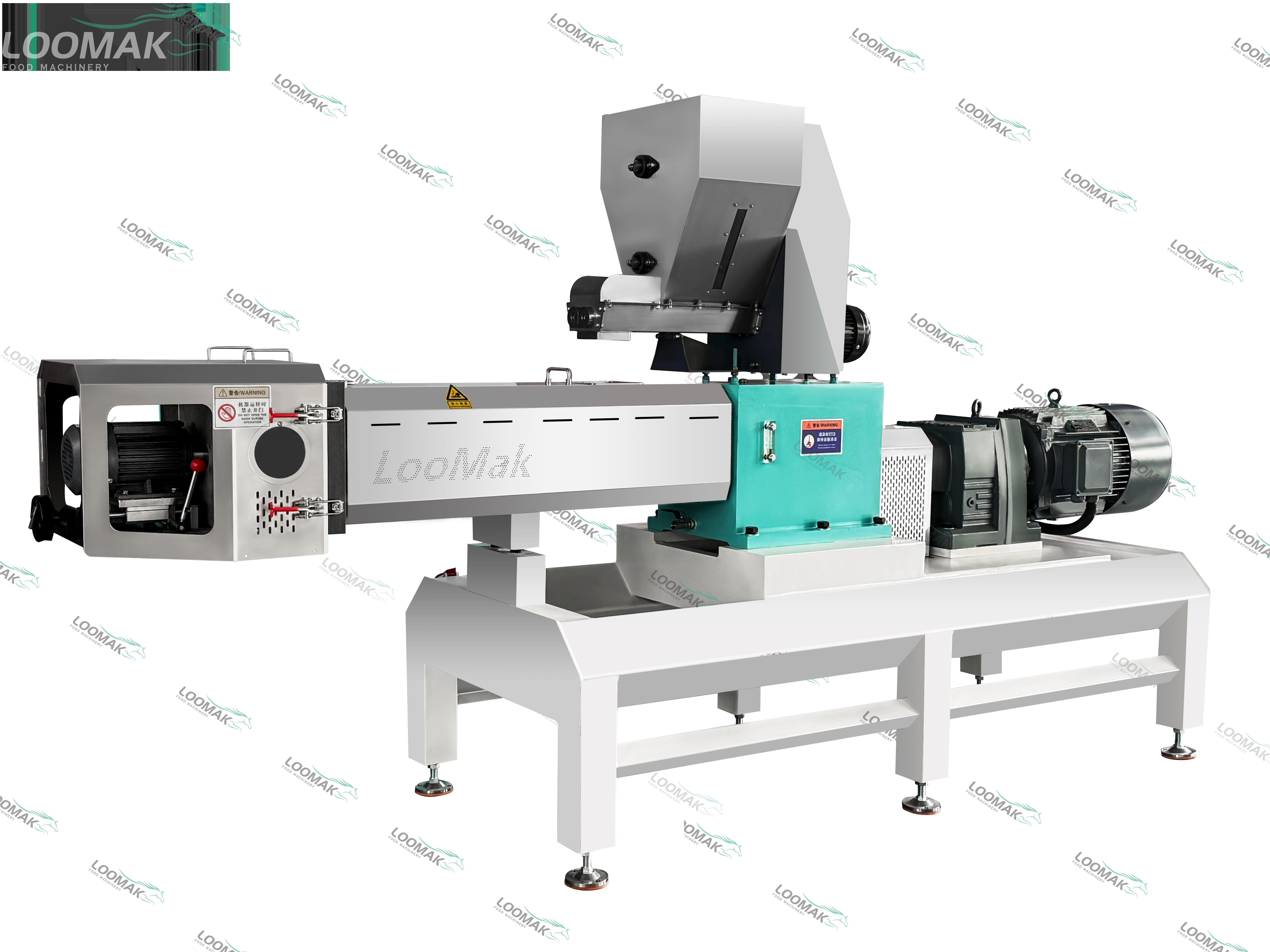
As a national high-tech enterprise based in Jinan, loomak focuses on the research, manufacturing, and process support of twin-screw extrusion, puffing equipment, and customized food deep-processing production lines. By integrating process development, equipment configuration, and control systems, the company helps food manufacturers build efficient extrusion solutions tailored to their product formulations, texture targets, and production requirements.
A: Moisture acts as a plasticizer in the extruder barrel. Optimal moisture allows for proper starch gelatinization and creates the vapor pressure necessary for expansion at the die. Too much moisture leads to a dense, hard texture, while too little causes excessive shear and burning.
A: Proteins tend to cross-link and form rigid networks during extrusion, which restricts the radial expansion of the melt as it exits the die. They also compete with starches for available water, leading to higher bulk density and a harder, less crisp texture.
A: Shear force, generated by the rotating screws, provides Specific Mechanical Energy (SME) that breaks down starch granules and mixes the dough. High shear typically increases expansion and creates a lighter, crispier texture, but excessive shear can degrade the matrix and cause stickiness.
A: Die stickiness is often caused by over-sheared starches or inadequate lubrication. It can be mitigated by adding a small percentage of lipids, slightly lowering the barrel temperature in the final zone, or utilizing modified starches with higher process tolerance.
A: Insoluble fibers can physically disrupt the continuous starch matrix and puncture the gas cells expanding at the die. This reduces radial expansion and diminishes crispness perception. Using finely milled fibers or adjusting the amylopectin ratio can help mitigate this effect.
A: Crispness is associated with a highly expanded product featuring thin cell walls that shatter easily with low force, producing high-frequency acoustic feedback. Crunchiness involves a denser structure with thicker cell walls, requiring higher fracture force and sustained chewing.


