Views: 0 Author: Site Editor Publish Time: 2026-07-22 Origin: Site
Specifying extrusion equipment involves high capital expenditure and massive operational stakes on the plant floor. Undersizing creates immediate production bottlenecks that choke your entire facility, while oversizing leads to wasted capital, excessive energy consumption, and poor product quality due to underfilled barrels. A common misconception among plant managers is that extruder capacity is a static number printed on a spec sheet. In reality, a manufacturer’s stated "kg/hr" is purely theoretical. It depends heavily on recipe formulation, bulk density, and specific mechanical energy (SME) requirements.
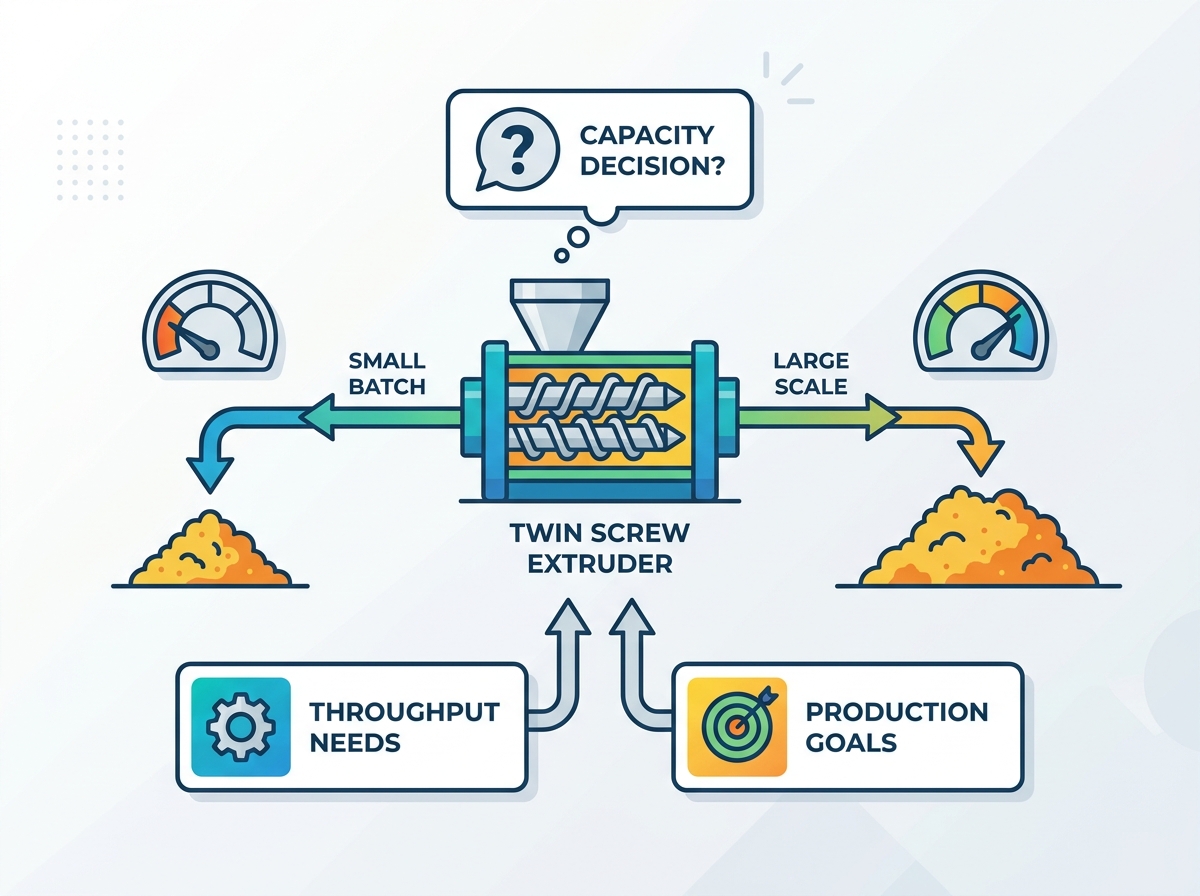
To accurately determine the required twin screw food extruder capacity, operators must look beyond catalog specifications and apply a rigorous technical evaluation framework. You need to calculate true capacity requirements based on your exact ingredients, align hardware specifications with product types, and mitigate implementation risks before procurement. This guide breaks down the engineering principles and field-tested variables needed to size your extrusion line correctly.

Theoretical vs. Actual Yield: A twin screw food extruder capacity rating is a baseline; actual throughput is dictated by ingredient bulk density, moisture content, and required residence time.
Process Limitations: Capacity is typically constrained by either volume (light, fluffy recipes) or torque (dense, viscous recipes). Identifying your process limit is critical for accurate sizing.
Hardware Interdependencies: Scaling capacity requires proportional scaling of motor power, gearbox torque ratings, and the Length-to-Diameter (L/D) ratio to maintain consistent product quality.
Upstream and Downstream Alignment: The true capacity of an extrusion line is limited by the slowest component. Extruder output must perfectly match the feeding systems upstream and the dryers, coaters, and coolers downstream.
Table of Contents
When evaluating a twin screw food extruder, you must separate the physical volume the machine can move from the actual weight of the product you intend to make. Volumetric capacity refers to the physical space inside the barrel between the screw flights. Mass throughput is the actual weight of the final product exiting the die per hour. High-volume, low-density materials fill the screw flights quickly, limiting mass throughput. Dense materials allow for higher mass throughput within the exact same volumetric space.
The ratio of outer screw diameter (Do) to inner screw diameter (Di) dictates the available free volume. This Do/Di ratio establishes the absolute physical limit for material flow. A higher ratio (e.g., 1.7 to 1.8) provides more free volume, which is highly advantageous for bulky ingredients like bran or light flours. A lower ratio (e.g., 1.4 to 1.5) offers higher shear and torque transmission for dense formulations like meat analogues.
Specific Mechanical Energy (SME) measures the mechanical energy transferred to the material from the main drive motor, typically expressed in kJ/kg or Wh/kg. The energy required to cook, shear, and melt specific food matrices directly impacts the maximum achievable throughput. If a product requires high SME, the motor power limits the mass throughput before the barrel is physically full. The relationship involves motor power, screw speed, torque, and mass throughput. High SME requirements necessitate powerful motors to maintain high capacities.
Screw speed (RPM) and volumetric fill factor must remain balanced. Pushing the RPM higher increases theoretical throughput but reduces residence time. It also increases product temperature beyond acceptable limits due to excessive shear friction. Operating at optimal fill levels ensures consistent shear history and product quality without overloading the drive system or degrading the food matrix.
Comparison of Capacity Limiting Factors | |||
Limiting Factor | Typical Product Profile | Primary Constraint | Hardware Solution |
|---|---|---|---|
Volumetric Limit | Expanded snacks, bran cereals | Barrel fills up before motor reaches max load | Higher Do/Di ratio, increased screw RPM |
Torque Limit | TVP, HMMA, dense pastas | Gearbox reaches max torque before barrel fills | High-torque gearbox, lower Do/Di ratio |
Thermal Limit | Heat-sensitive proteins, sticky starches | Product burns or degrades at high speeds | Longer L/D ratio, enhanced barrel cooling |
Recipe formulation dictates how a machine performs on the floor. Lightweight ingredients fill the screw volume rapidly. This reduces mass throughput compared to dense ingredients like heavy starches or meat slurries. Formulations with low bulk density hit volumetric limits long before reaching the motor's power capacity. Operators often have to densify raw materials upstream just to feed the extruder efficiently.
Water acts as a plasticizer during extrusion. Higher moisture generally increases throughput by reducing viscosity and torque load on the gearbox. The material flows easier, allowing the motor to push more mass. However, this requires more downstream drying capacity to remove the excess water. If your dryer cannot handle the moisture load, you must throttle the extruder, shifting the bottleneck from the extruder to the dryer.
Complex recipes requiring longer residence times for gelatinization or protein denaturation necessitate specific Length-to-Diameter (L/D) ratios. These typically range from 20:1 to 40:1. Longer barrels provide more cooking time but throttle overall feed rates due to increased friction and pressure build-up. You cannot simply push material faster through a long barrel without altering the cook profile.
The restriction at the die plates creates backpressure, which impacts the volumetric efficiency of the screw. High backpressure increases the degree of fill and residence time but directly restricts the actual twin screw food extruder capacity. The open area of the die must be precisely calculated to balance pressure and throughput. If the die area is too small, the extruder backs up, causing surging at the feed throat.
Measure the raw material bulk density before it enters the feeder.
Calculate the required moisture addition to achieve the target melt viscosity.
Determine the optimal L/D ratio based on the required thermal cook time.
Design the die plate open area to match the target backpressure and expansion rate.
Monitor the motor load to ensure the formulation does not exceed torque limits.
Inaccurate raw material feeding limits the practical operating capacity of any extrusion line. Volumetric feeders deliver material based on volume, which is highly susceptible to bulk density changes. If a batch of flour is slightly more aerated, the mass feed rate drops, starving the extruder. Loss-in-weight (LIW) feeders provide continuous mass flow control. They constantly weigh the material and adjust the auger speed, ensuring the extruder receives a consistent feed rate. This maximizes stable throughput and prevents barrel starvation.
Variations in raw material bulk density cause feeding inconsistencies even with good equipment. These fluctuations lead to surges in the extruder barrel. Surging creates artificial capacity bottlenecks and unstable product quality. Consistent milling and conditioning of raw materials are essential for maintaining steady extrusion rates. If your hammer mill screens wear out, the particle size changes, altering the bulk density and throwing off the entire extrusion process.
Injecting liquids or side-feeding dry ingredients down the barrel introduces severe throughput limitations. These additions consume free volume and alter the rheology of the melt mid-process. The capacity is often limited by the system's ability to incorporate and mix these secondary streams without causing surging or phase separation. Side feeders must be sized correctly to push material into a pressurized barrel without backing up.
Direct expanded snacks and cereals require high expansion and have low density. The capacity reality here is typically volume-limited. Production requires high screw speeds and moderate torque to achieve the necessary shear and expansion without exceeding the volumetric limits of the barrel. Operators focus on maximizing RPM and using aggressive screw profiles to generate the heat needed for rapid moisture flashing at the die.
Textured Vegetable Protein (TVP) and High Moisture Meat Analogues (HMMA) demand high shear, precise temperature control, and long cooling dies. The capacity reality is typically torque-limited and cooling-limited. Production requires robust gearboxes, high torque density, and longer L/D ratios to process dense, viscous plant proteins effectively. The cooling die often dictates the line speed; if you push HMMA through too fast, it won't texturize properly.
Pet food and aquatic feed require high throughput, high fat/protein content, and precise pellet sizing. The capacity reality requires high-capacity pre-conditioners to maximize extruder throughput. Pre-conditioning hydrates and partially cooks the mash using steam and water before it even hits the extruder. This reduces mechanical wear on the screws and drastically increases the extruder's mass throughput by shifting the thermal load upstream.
Product Category Extrusion Parameters | |||
Product Type | Typical L/D Ratio | SME Requirement (Wh/kg) | Primary Capacity Bottleneck |
|---|---|---|---|
Expanded Snacks | 15:1 to 20:1 | 100 - 150 | Volumetric Feed Limit |
TVP (Dry) | 20:1 to 25:1 | 120 - 180 | Motor Torque |
HMMA (Wet) | 25:1 to 40:1 | 150 - 250 | Cooling Die Length |
Pet Food | 15:1 to 20:1 | 40 - 80 | Pre-conditioner Retention Time |

Calculating required motor power is based on target throughput and anticipated SME. A robust drive system ensures the extruder can deliver the necessary mechanical energy without stalling or overheating. Adequate power reserves are critical for handling recipe variations and preventing unexpected downtime. If you size the motor exactly to your theoretical need, any slight increase in ingredient viscosity will trip the drive.
Torque density is a critical metric for modern extruders, measured in Nm/cm³. High-torque gearboxes allow for higher capacities in dense applications without increasing screw speed. Increasing screw speed on dense materials degrades product quality through excessive shear. A strong gearbox handles the heavy loads required for viscous materials like HMMA, allowing you to run full barrels at lower RPMs for better quality control.
Adding a pre-conditioner can increase capacity by 20% to 50%. It shifts thermal and moisture energy input away from the extruder barrel. By pre-heating and hydrating the raw materials, the extruder requires less mechanical energy to complete the cooking process. This allows for significantly higher mass throughput rates and extends the lifespan of your screw elements by reducing dry friction in the feed zone.
Scaling up capacity presents massive engineering challenges. Volumetric capacity scales by the cube of the diameter, whereas heat transfer area scales only by the square. This discrepancy means larger extruders have significantly less surface area per unit volume for heating or cooling. You cannot simply copy the temperature profile from a 24mm lab extruder to a 96mm production machine. You must adjust the screw profile and rely more on mechanical shear for heating.
Mathematical relationships are used to maintain product quality during scale-up. Keeping specific energy input and residence time distribution constant ensures the commercial product matches the pilot plant results. Adjustments to screw speed, feed rate, and barrel temperatures are necessary to replicate the required shear history. Engineers use scale-up software, but field adjustments are always required during commissioning.
Translating pilot-scale throughput data to commercial production capacities requires careful verification. Running pilot trials with exact formulations helps identify SME requirements and volumetric limits. This data forms the baseline for calculating the required motor power, torque, and L/D ratio for the production-scale machine. Never buy a production machine based on generic data; always test your specific recipe.
Record baseline SME and torque values during pilot trials.
Calculate the volumetric scale-up factor based on the Do/Di ratio.
Adjust barrel temperature setpoints to compensate for reduced heat transfer surface area.
Modify the screw profile to match the residence time distribution of the pilot machine.
Verify die pressure and expansion ratios at the new production scale.

Oversizing an extruder leads to low fill levels in the barrel. This causes inconsistent shear, surging at the die, and poor product uniformity. The material slips over the screws rather than being conveyed and kneaded properly. It also results in severe operational inefficiency, including wasted electrical energy, higher utility minimums, and excessive wear on screw elements due to metal-to-metal friction when the barrel is underfed.
Running constantly at maximum motor load or torque limits increases the risk of catastrophic gearbox failure. Undersizing caps revenue potential and forces premature secondary capital investments to meet production demands. It restricts flexibility to handle denser or more demanding formulations. If your machine runs at 95% load on day one, you have zero room for process optimization or recipe changes.
Utility requirements do not scale linearly with extruder size. As extruder capacity increases, the demands for steam, cooling water, and electrical power grow significantly. Facilities must ensure adequate infrastructure is in place to support the peak utility loads of large-scale extrusion lines. A 5-ton-per-hour line requires massive steam boilers and chilled water systems that often exceed existing plant capacities.
Larger extruders require substantially more physical floor space. This includes space for correspondingly larger pre-conditioners, maintenance access clearances, and raw material silos. You need room to pull the screws for cleaning and maintenance. Facility layout must accommodate the extended length of high L/D extruders and the heavy rigging equipment needed to service the gearboxes and motors.
Auditing existing downstream equipment is a critical necessity before upgrading extruder capacity. Dryers, flavor drums, and packaging lines must be capable of handling the increased output. If the dryer cannot process the higher mass throughput or remove the required moisture, the extruder must be throttled. This completely negates the investment in a higher capacity extrusion line.
Selecting the right twin screw food extruder capacity is essential for achieving stable production, consistent product quality, and long-term operational efficiency. By accurately evaluating product requirements, process parameters, and equipment specifications, manufacturers can maximize throughput while minimizing production costs and future expansion risks.
At LOOMAK, we specialize in advanced twin screw food extrusion equipment and customized production solutions for manufacturers worldwide. Our engineering team provides professional technical support to help customers optimize extrusion capacity, improve production efficiency, and build reliable, scalable food processing systems.
Before purchasing a new extrusion line, evaluate your product portfolio, expected production capacity, raw material characteristics, utility conditions, and future expansion plans to ensure the most efficient and cost-effective equipment investment.
A: Commercial capacities range from 100 kg/hr for specialty pilot lines up to 10,000 kg/hr or more for large-scale pet food or cereal production. The exact capacity depends heavily on the specific product density, moisture content, and required mechanical energy.
A: Manufacturer ratings are theoretical maximums based on ideal, dense materials like raw wheat. Actual throughput is often lower due to low ingredient bulk density, high specific mechanical energy requirements, or severe restrictions at the die plate.
A: Yes, but running significantly below design capacity causes low barrel fill levels. This leads to inconsistent shear, surging, poor product quality, and accelerated wear on the screw elements due to a lack of material lubrication.
A: A longer L/D ratio provides more residence time for cooking and mixing but increases friction and backpressure. This can throttle the maximum feed rate, potentially reducing volumetric capacity compared to a shorter barrel running the same recipe.
A: Low bulk density ingredients fill the screw volume quickly, limiting the mass throughput. Dense ingredients allow more weight to be processed within the same volumetric space, maximizing the extruder's mass capacity before hitting volumetric limits.
A: Yes. A pre-conditioner adds thermal energy and moisture before the material enters the extruder barrel. This reduces the mechanical energy required from the extruder motor, allowing for significantly higher mass throughput rates.


