Views: 0 Author: Site Editor Publish Time: 2026-08-05 Origin: Site
The commercial snack market is shifting rapidly from traditional corn-based products to complex, high-protein, and alternative-grain formulations. This shift places new demands on manufacturing infrastructure. Transitioning a benchtop snack formulation to full-scale commercial production requires precise control over thermo-mechanical processes. Misalignment between raw ingredients, moisture levels, and extrusion machinery leads to inconsistent bulk density, poor texture, and high waste on the plant floor.
Understanding exactly how are puffed snacks made through industrial extrusion is critical for food scientists, production managers, and investors evaluating equipment purchases or co-manufacturing partnerships. This guide breaks down the mechanics of extrusion, equipment selection criteria, and production line optimization. We will look at the exact physical changes happening inside the barrel and how operators manipulate those variables to achieve specific product textures.

Formulation Dictates Machinery: Traditional starch-based snacks can utilize cost-effective single-screw extruders, while complex matrices (like whey isolate or pea protein) require the advanced shear control of twin-screw systems.
The Physics of the Puff: Expansion is driven by a rapid pressure drop at the die plate, causing superheated moisture to flash off and expand the gelatinized starch or protein matrix.
Process Control is Critical: Profitability hinges on managing the expansion ratio and bulk density through precise manipulation of barrel temperature, screw speed, and feed moisture.
End-to-End Line Integration: Extrusion is only one phase; downstream drying, flavoring, and cooling systems must be perfectly synchronized to prevent product collapse or sogginess.
Table of Contents
To evaluate equipment, buyers must first understand the fundamental thermo-mechanical reactions required to achieve a specific texture and crunch. You cannot just push dry powder through a heated pipe and expect a consistent puff. The process relies on a delicate balance of mechanical shear, thermal energy, and pressure.
Inside the extruder barrel, a rotating screw generates intense friction. This mechanical shear, combined with external heating jackets, transforms dry powder into a viscoelastic melt. Frictional heat does the heavy lifting here. While external barrel heating elements help maintain target temperatures, the mechanical energy dissipation from the screw profile actually cooks the dough mixture efficiently. As the material moves toward the discharge end, the screw geometry restricts flow, causing pressure to build up significantly. This pressure often exceeds 30 to 40 atmospheres just before the die plate.
Raw materials undergo massive structural transformations during this short residence time. Starches gelatinize to form a continuous web. This web is the structural foundation of the snack. It traps steam and creates the cellular structure you see when you bite into a cheese puff. Proteins behave differently. They must be denatured and aligned without burning. If you apply too much thermal energy, the protein matrix becomes rigid and fails to expand. If you apply too little, the dough remains raw and dense.
Material Type | Primary Transformation | Shear Requirement | Expansion Potential |
|---|---|---|---|
Corn/Rice Starch | Gelatinization | Moderate | Very High |
Whey Protein Isolate | Denaturation | High/Precise | Low to Moderate |
Pea Protein | Denaturation/Alignment | High | Moderate |
Wheat Flour | Gluten Network Formation | Moderate | High |
The exact moment the melt exits the die into ambient pressure dictates the final product quality. The sudden drop in pressure causes a thermodynamic flash-off. Superheated water trapped in the melt instantly converts into steam. This rapid phase change creates the cellular structure, blowing bubbles within the continuous starch or protein web. The matrix then rapidly cools and solidifies into a rigid foam. If the temperature is too low at the die, the moisture does not flash off fast enough, resulting in a hard, tooth-breaking texture.
Different ingredient bases require distinct processing parameters and equipment capabilities. You cannot run a high-protein pea crisp on the same exact settings as a standard corn puff. The rheology of the melt changes entirely based on the input materials.
Traditional starches, such as cornmeal, rice, and wheat, provide the baseline requirements for standard cheese puffs and crisps. Ingredients rich in amylopectin, like cornmeal and rice flour, have a high expansion index. They melt easily, hold gas well, and form a light, airy structure. Operators usually run these on simpler screw profiles with standard moisture levels.
Extruding low-starch or high-protein formulations presents severe technical difficulties. These mixtures are prone to burning, poor expansion, and tough textures. Pure whey protein isolates (WPI) tend to gel prematurely. When they gel in the transition zone of the barrel, they clog the extruder die, causing pressure spikes and forcing a line shutdown.
Identify the protein concentration target for the final product.
Select a compatible starch carrier, such as rice flour or tapioca starch, to provide the expansion web.
Adjust the screw profile to include kneading blocks that provide enough shear to denature the protein without causing premature cross-linking.
Monitor the die pressure closely, as protein melts are highly viscous and can cause rapid pressure fluctuations.
Specific binding agents or starch carriers are necessary to carry the protein through the extruder successfully. Commercial standards like Shrewd Food or Twin Peaks rely on precise ratios of protein to carrier starches to achieve their texture.
Input moisture acts as the primary blowing agent. For direct expansion, operators typically target 12% to 20% moisture in the feed. Too much moisture results in a dense, gummy product because the steam does not have enough energy to expand the heavy melt. Too little moisture leads to a burnt product, excessive machine wear, and severe surging at the die. Maintaining a consistent feed rate and moisture level is the most critical operational task on the floor.
Comparing machinery based on capital expenditure, operational flexibility, and formulation complexity dictates the success of your facility. You must match the machine to the specific rheological demands of your product portfolio.
Single-screw extruders offer a lower initial capital investment and simpler maintenance. They are ideal for uniform, high-starch inputs like traditional corn puffs. The single rotating screw relies heavily on the friction between the material and the barrel wall to move the product forward. However, they have poor mixing capability. They are highly sensitive to moisture variations and are completely unsuitable for sticky, high-fat, or high-protein recipes. If the material slips on the barrel wall, forward conveying stops, and the machine plugs.
Twin-screw extruders provide superior mixing and positive displacement. The intermeshing screws physically push the material forward, preventing slipping regardless of the material's viscosity or fat content. They offer precise control over shear, residence time, and temperature profiles. This makes them capable of handling complex, multi-ingredient formulations.
Feature | Single-Screw Extruder | Twin-Screw Extruder |
|---|---|---|
Conveying Mechanism | Friction-dependent | Positive displacement |
Mixing Capability | Poor to Moderate | Excellent |
Ingredient Flexibility | Low (Starch mostly) | High (Proteins, fats, fibers) |
Moisture Sensitivity | High | Low |
Maintenance Complexity | Low | High |
Modern extruders utilize modular barrel designs. This allows operators to set targeted heating and cooling zones, typically divided into feed, transition, and metering zones. You can configure the screw profile by sliding different conveying and kneading elements onto the splined shafts. The die shape significantly impacts the final product geometry and expansion dynamics. A die with a high open area reduces backpressure, while a restrictive die increases shear and expansion.
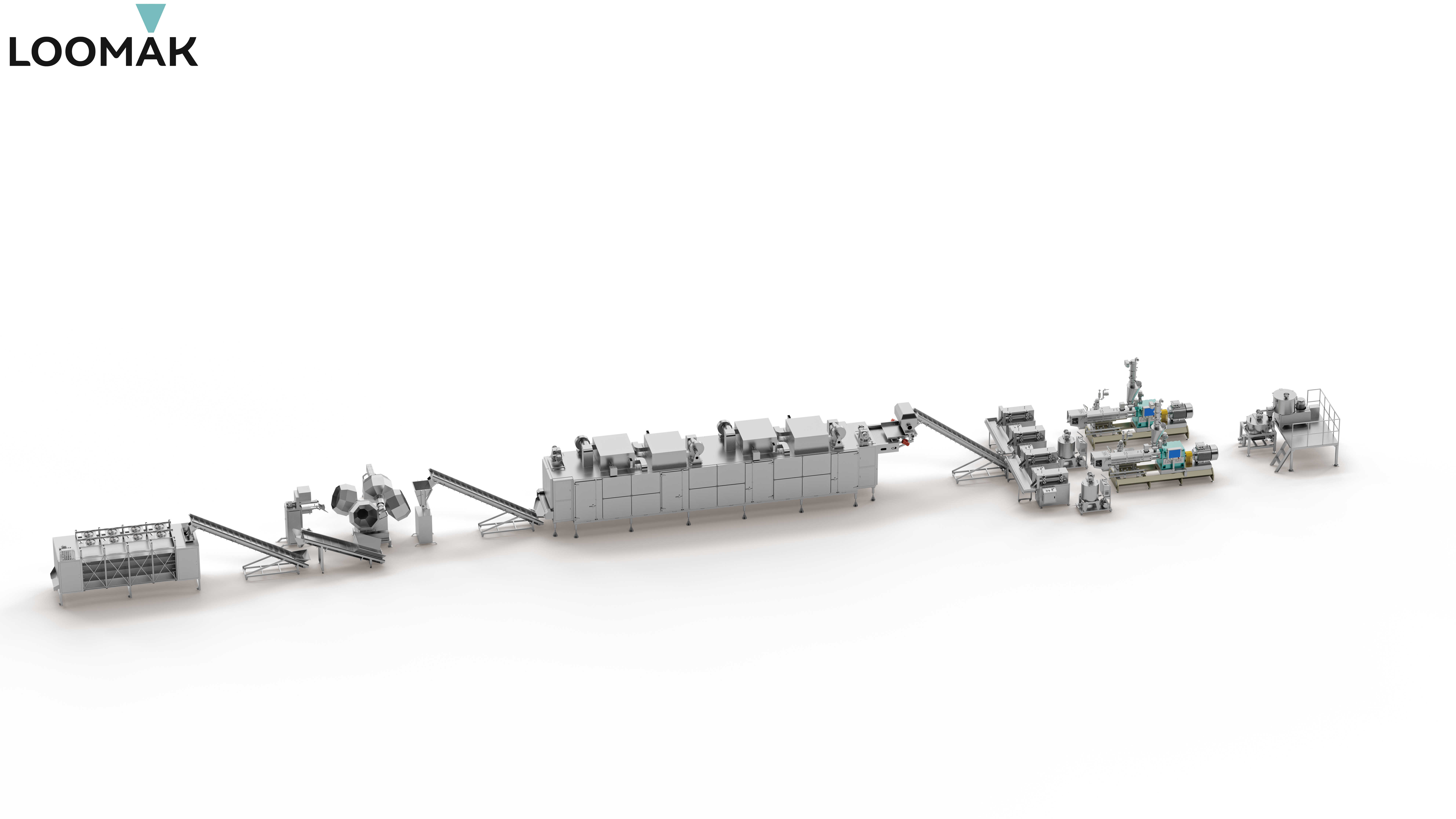
A successful production line requires seamless integration of upstream and downstream equipment. The extruder is just the engine; the rest of the line determines if the product is actually salable.
Uniform hydration and mixing before raw materials enter the extruder prevent surging. If the moisture varies by even 1%, the expansion ratio at the die will fluctuate, causing inconsistent bag weights. Continuous screw feeders and pneumatic conveyors maintain a highly consistent feed rate into the pre-conditioner or extruder throat.
Direct expansion occurs when the product puffs immediately at the die. The moisture flashes off, and the product is cut to length. Indirect expansion creates a dense "half-product" or pellet. The extruder cooks and forms the dough, but the temperature at the die is kept below the boiling point of water. The pellet is then cooled, dried, and puffed later in a separate process.
Face-cutters: High-speed rotary blades mounted directly on the die face cut direct-expanded products. Blade speed calibration controls piece length and weight.
Post-extrusion forming: Used for indirect pellets, where the dense dough is sheeted, stamped, or cut into specific shapes before drying.
Extruded snacks exit the die with a moisture content around 8% to 10%. They must pass through a multi-pass dryer or oven to reduce moisture down to 1% to 3%. This step ensures shelf stability and provides the final crisp texture. If you package a product at 8% moisture, it will become stale and moldy within weeks.
Flavor coating happens in continuous rotating drums. Commercial cheese slurry applications require emulsifying cheese powders with oil or fat carriers. Operators must use heat tracing on the slurry lines to prevent the fat from solidifying and clogging the spray nozzles. Dry seasoning methods involve spraying a light oil tack coat followed by dusting the dry powder. Slurry applications add moisture back into the product, which must be accounted for in the final shelf-life calculations.
For products requiring a different texture profile or third-party finishing, indirect expansion offers a distinct operational advantage. You produce a dense pellet that can be shipped efficiently and puffed on demand.
Drying indirect pellets to a stable, glassy state (around 10% to 12% moisture) allows for long-term storage. Co-packers often buy these half-products and run them through their own puffing and flavoring lines. This decentralizes production and reduces shipping costs, as you are not paying to transport air.
Frying pellets in hot oil results in rapid expansion and a highly palatable, high-fat product. The oil replaces the moisture as it flashes off. Hot air puffing requires fluidized bed roasters. The intense hot air expands the pellet without adding fat, yielding a healthier nutritional profile but a drier texture. Emerging technologies like microwave and vacuum puffing offer oil-free, high-expansion snacks. These systems use electromagnetic energy or pressure differentials to expand the pellet, though scalability and energy costs remain challenging for high-volume commodity snacks.
Common operational failures happen daily on extrusion lines. You must engineer these risks out of the process through strict quality control and preventative maintenance.
Inconsistent product weight leads to packaging issues and margin loss. If the bulk density drops, the bags overfill and jam the packaging machine. If the bulk density increases, you give away free product to meet the label weight. Implementing automated inline bulk density sensors and closed-loop feedback to the extruder screw speed mitigates this risk.
Hardness/Lack of Crunch: Usually a symptom of low mechanical shear, incorrect extrusion temperature, or insufficient moisture flash-off. Increase screw speed or adjust the die restriction.
Uneven Puffing/Cell Structure: Often caused by poor pre-mixing, inconsistent feed rates, or worn extruder screws. Check the ribbon blender for dead spots.
Surging at the Die: Indicates a feed issue or bridging in the hopper. Ensure the pneumatic conveying system is delivering a steady flow of raw material.
Abrasive ingredients, like certain fibers, minerals, or hard proteins, cause severe wear and tear on screws and dies. As the screw flights wear down, the clearance between the screw and the barrel increases. This reduces the positive displacement efficiency and lowers the shear rate. Investing in specialized metallurgical coatings for extruder parts extends their lifespan and maintains consistent product quality over longer runs.
Based in Jinan, Loomak specializes in twin-screw extrusion equipment, puffing machinery, and customized food processing production lines. With experience in equipment configuration and production process planning, Loomak helps snack manufacturers improve production stability, product consistency, and overall operating efficiency.
Conduct pilot-plant trials with an equipment manufacturer to validate your formulation's extrusion behavior before committing to commercial-scale equipment.
Install automated inline bulk density sensors to maintain strict control over packaging weights and product consistency.
Implement a preventative maintenance schedule focused on measuring screw and barrel wear to prevent unexpected downtime.
Standardize your pre-conditioning and mixing procedures to ensure absolute moisture uniformity before the material enters the extruder throat.
A: Direct expansion occurs immediately as the product exits the extruder die, creating a puffed snack instantly due to moisture flash-off. Indirect expansion produces a dense, unpuffed pellet. This pellet requires a secondary process, like hot oil frying or hot air popping, to achieve the final expanded texture.
A: It is highly discouraged. High-protein formulations require precise shear, positive displacement, and strict temperature control to prevent burning and ensure proper expansion. Single-screw machines lack the mixing capability and rely on friction, which often causes protein melts to slip or plug the barrel.
A: Moisture acts as the primary blowing agent. When the pressurized melt exits the die, the superheated moisture flashes off into steam, creating the cellular puffed structure. Incorrect moisture levels lead to dense, gummy, or burnt products, and cause surging at the die plate.
A: Utilize heat tracing on all slurry lines and jacketed tanks to maintain the correct temperature and viscosity of the fat carrier. Ensure the cheese powder is thoroughly emulsified with the oil using high-shear mixers before it reaches the application nozzles.
A: Uneven puffing is typically caused by poor pre-mixing of raw ingredients, resulting in localized moisture variations. It can also be caused by inconsistent feed rates into the extruder or worn screw flights that fail to generate uniform pressure and shear.
A: Bulk density is controlled by manipulating the expansion ratio. You adjust the extruder screw speed, barrel temperature, feed moisture, and die open area. Higher shear and temperature generally increase expansion, lowering the bulk density.


