Views: 0 Author: Site Editor Publish Time: 2026-08-05 Origin: Site
The global snack market segments heavily by nutritional profiles and texture preferences. This places immense pressure on plant managers and process engineers to select the correct processing methodology for extruded products. Deciding between a fried or baked production line dictates capital expenditure, facility footprint, operational expenses, safety compliance, and the final product’s market positioning. This guide provides a technical evaluation of fried vs baked puffed snacks. We detail the equipment requirements, thermodynamic processes, and commercial trade-offs necessary to architect a profitable and scalable production line. You will learn how to evaluate equipment footprints, manage oil degradation, and optimize thermal drying cycles for maximum yield.
Process Divergence: Both methods rely on twin-screw or single-screw extrusion for initial starch gelatinization, but diverge critically at the moisture-reduction and expansion phase (hot oil flash-evaporation vs. forced hot-air convective drying).
Equipment Footprint & CAPEX: Baked lines typically require larger continuous multi-tier drying ovens with a significant horizontal floor space, while fried lines require complex oil management, filtration, heat exchangers, and advanced fire suppression systems.
Operational Economics: Fried snacks incur high ongoing OPEX due to cooking oil consumption, turnover rates, and degradation, whereas baked snacks are highly dependent on local industrial energy costs (gas or electric) for prolonged thermal drying.
Market Positioning: Baked processes enable "low-fat" and "better-for-you" claims but require secondary oil-spray or slurry-enrobing systems for seasoning adhesion; fried processes deliver traditional indulgent textures with naturally high seasoning retention.
Table of Contents
Extruded snack production begins with precise raw material conditioning. Operators mix corn meal, rice flour, or alternative grain bases to exact moisture levels. This typically ranges from 15% to 20%. This hydration step facilitates proper starch maturation during the subsequent thermo-mechanical processing phase. Inconsistent moisture distribution at this stage directly impacts expansion ratios and final product bulk density. Plant personnel must calibrate volumetric or gravimetric feeders to ensure a consistent mass flow rate into the pre-conditioner. We often see operators use high-speed paddle mixers to achieve a homogenous moisture profile across the dry mix before it enters the extruder barrel.
Water temperature during the conditioning phase also plays a role. Injecting warm water or low-pressure steam accelerates hydration. This reduces the mechanical energy required later in the extruder. Operators must monitor the dwell time in the pre-conditioner. A standard dwell time of two to three minutes allows water to penetrate the starch granules fully. If the mix is too dry, the extruder will draw excessive motor amperage. If it is too wet, the product will not expand properly at the die face.
Inside the extruder barrel, mechanical shear forces and thermal energy work simultaneously to cook the raw matrix. Barrel temperatures are strictly regulated between 100°C and 140°C. The combination of high internal pressure, specific mechanical energy, and controlled heat gelatinizes the starches. This transforms the granular mix into a viscous, cohesive dough ready for shaping. Twin-screw extruders offer superior control over this process compared to single-screw models. They provide positive displacement, meaning the dough moves forward regardless of its viscosity or moisture content.
Screw configuration dictates the amount of shear applied to the dough. Forward-conveying elements move the material quickly. Kneading blocks and reverse-pitch elements increase residence time and mechanical shear. Operators adjust the screw speed to control the specific mechanical energy input. Higher screw speeds generate more friction, increasing the dough temperature. Cooling jackets around the barrel zones prevent the dough from overheating and degrading. Proper temperature management ensures the starch gelatinizes completely without burning.
The fundamental split between processing methods occurs at the die-face cutting stage. As the pressurized dough exits the die, it expands slightly and is sliced by rotary knives into semi-moist collets or pellets. From this exact point, the product is immediately routed to either a continuous fryer or a multi-pass dryer. This routing dictates the final structural rigidity, starch ripening, and moisture content. The moisture must drop below 2% to 4% for shelf stability. The speed of the rotary cutter determines the length of the collet. Faster cutter speeds produce shorter puffs. Slower speeds produce longer sticks or tubes.
Pneumatic conveying systems transport the wet collets from the extruder to the next processing stage. These systems use high-velocity air to move the product through stainless steel tubing. Operators must balance the air velocity to prevent product damage. Too much air speed shatters the fragile collets. Too little air speed causes blockages in the piping. The conveying distance should be as short as possible to minimize heat loss and moisture evaporation before the frying or baking stage.
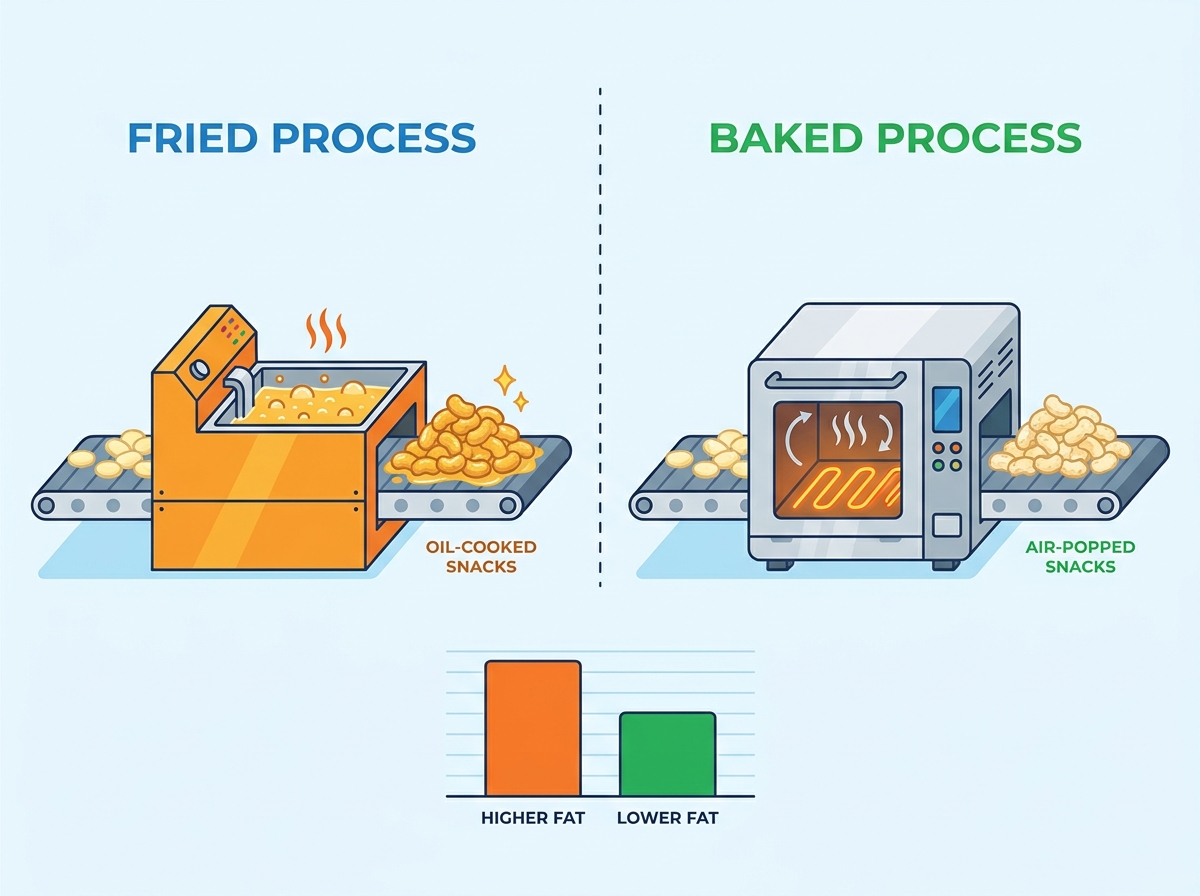
Frying utilizes hot fat or oil, typically maintained between 160°C and 180°C, as a rapid heat transfer medium. When the semi-moist collet enters the oil, residual moisture flash-evaporates. This violent thermodynamic reaction causes instantaneous structural expansion. It creates a highly porous, crispy cell matrix characteristic of traditional extruded snacks. The rapid expansion locks the starch structure in place. The escaping steam creates microscopic voids within the collet, giving it a light, airy texture.
The type of oil used affects the final product flavor and shelf life. High-oleic sunflower oil or palm olein are common choices due to their high smoke points and oxidative stability. The oil acts as both a heating medium and an ingredient. As water leaves the collet, oil enters the voids left behind. This oil uptake contributes to the rich mouthfeel and caloric density of the snack. Operators must monitor the oil temperature closely. Temperature drops lead to excessive oil absorption and a greasy product.
Continuous Fryers: Industrial lines utilize multi-zone continuous fryers equipped with submerged conveying systems and variable speed drives. Precise temperature zoning ensures uniform cooking and prevents product scorching.
Oil Management Systems: Active oil filtration using paper or diatomaceous earth is mandatory. Heat exchangers and bulk oil storage tanks work in tandem to maintain free fatty acid levels and prevent thermal degradation.
De-Oiling Centrifuges: Post-fryer processing requires specialized equipment to strip excess surface oil immediately. Failure to remove this oil results in greasy textures and accelerates rancidity during storage.
Vapor Exhaust Hoods: High-capacity exhaust fans remove steam and volatile oil compounds from the frying area. This maintains a safe working environment and prevents condensation from dripping back into the fryer.
Oil turnover rate is a primary operational metric. Fried products can retain 25% to 35% oil by weight. This necessitates continuous fresh oil replenishment to stabilize overall oil quality. Frying is a highly efficient moisture-reduction method. It enables higher throughput velocities and significantly shorter residence times per batch compared to convective drying. A typical frying dwell time ranges from 30 to 60 seconds. This rapid processing allows for high-volume production in a relatively compact footprint.
Operators must manage the oil level in the fryer automatically. Float switches or radar sensors detect the oil level and trigger makeup pumps. The fresh oil should be pre-heated before entering the fryer to prevent temperature fluctuations. Regular oil testing is necessary to monitor free fatty acids and polar compounds. When these markers exceed acceptable limits, the oil must be discarded or heavily filtered. Proper oil management directly impacts product quality and operational costs.
The high lipid retention inherent to frying yields a softer, traditional melt-in-the-mouth crunch with rapid flavor release. However, this lipid content increases susceptibility to oxidation. Manufacturers must utilize specific barrier packaging, such as metallized films. They must also implement nitrogen flushing protocols to maximize product shelf life. The oil on the surface of the snack acts as an excellent binder for dry seasonings. This eliminates the need for a separate liquid tacking agent during the flavoring stage.

Baking relies on forced hot air convection, with temperatures typically ranging from 100°C to 150°C. This method slowly draws out moisture and finalizes product expansion without introducing external lipids during the structural stabilization phase. The resulting cell structure is generally denser and firmer than its fried counterpart. The drying process occurs in two stages. First, surface moisture evaporates rapidly. Second, internal moisture diffuses to the surface and evaporates. This second stage is slower and requires careful temperature control.
Air velocity and humidity within the dryer are critical parameters. High air velocity increases the heat transfer rate. However, if the air is too dry, the product surface hardens prematurely. This case hardening traps internal moisture, leading to a chewy texture and potential mold growth during storage. Operators adjust exhaust dampers to maintain a specific humidity level within the drying chamber. This controlled humidity keeps the product surface pliable while the internal moisture escapes.
Continuous Multi-Pass Dryers: Baked lines utilize multi-tier conveyor dryers or impingement ovens. These structures are engineered to maximize surface area exposure while attempting to minimize the overall floor footprint.
Airflow and Exhaust Systems: Specialized venting systems release evaporated moisture, maintain consistent air velocity, and prevent condensation within the drying chambers.
Flavoring Drums: Because the base collet emerges dry post-bake, the system must incorporate an enrobing drum. This drum sprays a calibrated mist of oil or liquid seasoning slurry to act as a binding agent for dry spices.
Cooling Conveyors: After baking, the product must be cooled to ambient temperature before packaging. Ambient air is drawn through the product bed to remove residual heat and halt the cooking process.
Baked lines exhibit a high reliance on industrial energy sources like natural gas, steam, or electricity to maintain consistent drying temperatures. Residence times are longer, often spanning 5 to 15 minutes depending on product density. Operators must carefully manage moisture uniformity across the conveyor belt. Uneven loading leads to wet spots and inconsistent product quality. Oscillating spreaders distribute the wet collets evenly across the width of the dryer belt.
Energy recovery systems can improve the efficiency of baked lines. Heat exchangers capture thermal energy from the exhaust air and use it to pre-heat incoming fresh air. This reduces the load on the primary burners or heating elements. Regular maintenance of the dryer belts is necessary to ensure proper airflow. Product crumbs and dust can clog the belt mesh, restricting air circulation and causing uneven drying. Operators use rotary brushes and air knives to clean the belts continuously during operation.
Evaluation Criteria | Fried Production Lines | Baked Production Lines |
|---|---|---|
Capital Expenditure | Higher complexity in ancillary equipment (filtration, fire suppression). | Lower fluid dynamic complexity; high cost for large thermal dryers. |
Facility Footprint | Smaller linear footprint; requires vertical/external space for oil silos. | Demands significant linear floor space and robust HVAC ducting. |
Maintenance & Sanitation | Intensive daily sanitation to prevent carbonized buildup. | Routine vacuuming of crumbs; strict combustible dust monitoring. |
Changeover Speed | Complex and slow if frying oil becomes flavor-contaminated. | Fast changeovers; flavoring isolated to post-drying enrobing stage. |
Utility Consumption | High natural gas usage for oil heating; high fresh water for boil-outs. | High electricity or gas usage for prolonged air heating. |
Fried production lines present higher complexity in ancillary equipment. They demand integrated filtration, thermal oil heating, and specialized fire suppression systems. While the linear footprint is often smaller, vertical space or external infrastructure is required for bulk oil silos. You must account for the piping runs between the storage tanks and the fryer. Conversely, baked production lines involve lower complexity regarding fluid dynamics. However, industrial multi-pass dryers demand substantial linear floor space. You need robust HVAC exhaust integration to handle the moisture load.
When planning a facility layout, consider the material flow. Fried lines require a dedicated oil receiving area. Tanker trucks need access to pump fresh oil into the storage silos. Baked lines require more space for the cooling conveyors and flavoring drums. The flavoring area must be isolated to prevent spice dust from migrating into the extrusion or drying zones. Proper zoning ensures food safety and prevents cross-contamination between different product runs.
Sanitation requirements differ drastically. Fried lines necessitate intensive daily cleaning to prevent carbonized buildup and oil rancidity. Operators perform boil-outs using caustic chemicals to remove polymerized oil from the fryer walls and heat exchangers. You must strictly adhere to NFPA fire codes for combustible liquids. Baked lines require routine vacuuming and air-lance cleaning of crumbs and dust. While the fire risk is lower, facilities must strictly monitor combustible dust accumulation. You must comply with industrial safety standards regarding explosive dust environments.
Preventative maintenance schedules vary between the two systems. Fried lines require frequent inspection of pump seals, valves, and filtration media. Thermal fluid heaters need annual inspections to ensure burner efficiency and tube integrity. Baked lines require regular lubrication of conveyor bearings and inspection of burner ignition systems. You must calibrate temperature and humidity sensors frequently to maintain drying accuracy. Both systems require dedicated maintenance personnel with specific skill sets.
Both systems offer scalability from entry-level configurations of 100 kg/h to high-capacity industrial lines exceeding 1000 kg/h. Line versatility heavily favors baked systems. Allergen and flavor changeovers on fried lines are highly complex if the frying oil becomes contaminated. This often requires full system drainage and boil-outs. Baked lines allow for faster changeovers. Flavoring and oiling are strictly isolated to the post-drying enrobing stage. You can run a plain base product continuously and apply different flavors in parallel seasoning drums.
Scaling up a fried line involves increasing the fryer length and oil volume. You must upgrade the thermal fluid heater to match the increased heat load. Scaling up a baked line involves adding more drying zones or increasing the belt width. You must ensure the exhaust system can handle the increased moisture removal rate. Modular dryer designs allow for easier expansion compared to custom-built fryers. Consider your long-term production goals when selecting the initial equipment size.
Operating industrial snack lines involves inherent risks. Equipment failures or process deviations lead to significant product loss and downtime. You must implement robust control systems and standard operating procedures to mitigate these risks. Training operators to recognize early warning signs is critical for maintaining production efficiency.
Risk: Oil Degradation and Free Fatty Acid Spikes in Fried Lines. Mitigation involves implementing automated FFA sensors and continuous active filtration systems. This maintains oil quality without requiring frequent, costly complete oil dumps.
Risk: Inconsistent Moisture and Textural Non-Uniformity in Baked Lines. Mitigation requires deploying in-line near-infrared moisture sensors at the dryer exit. These sensors automatically modulate conveyor belt speed and oven zone temperatures.
Risk: Seasoning Loss and Low Adhesion on Baked Snacks. Mitigation includes utilizing electrostatic seasoning applicators and precisely calibrated, heated slurry-spray nozzles. This ensures uniform coating without over-saturating or weakening the baked collet structure.
Risk: Fire Hazards in Frying Operations. Mitigation requires installing automated CO2 or water mist fire suppression systems directly above the fryer hood. You must interlock these systems with the thermal fluid heater to shut down the heat source immediately upon activation.
Risk: Combustible Dust Explosions in Baked Lines. Mitigation involves installing explosion panels on the dryer exhaust ducting and utilizing intrinsically safe electrical components in the flavoring area.
The choice between processing methodologies hinges primarily on target market demographics and available facility infrastructure. Manufacturers must weigh indulgent, high-flavor profiles against health-conscious, low-fat positioning. You must evaluate oil handling capabilities versus floor space for thermal dryers. Opt for fried lines if maximizing throughput velocity and achieving traditional textures are primary operational goals. Opt for baked lines if targeting premium better-for-you markets and requiring high flexibility in base-recipe changeovers.
Conduct pilot-plant trials using your exact raw material matrix on both continuous frying and convective drying equipment.
Calculate local utility rates against projected oil consumption volumes to determine long-term operational expenses.
Map out your facility floor plan to verify linear space for multi-pass dryers versus vertical space for oil silos.
Consult with local fire marshals regarding NFPA compliance for bulk oil storage and thermal fluid heating systems.
For manufacturers planning fried or baked puffed snack production, Loomak specializes in twin-screw extrusion, puffing equipment, and customized food deep-processing production lines. By integrating process planning, equipment manufacturing, and control support, the company helps customers develop production solutions suited to their product specifications, capacity targets, and factory conditions.
A: The main difference lies in the moisture-reduction and expansion phase post-extrusion. Fried snacks use hot oil for rapid flash-evaporation and expansion, resulting in high lipid content. Baked snacks use forced hot air convection to slowly dry and expand the product without adding external fats during the cooking stage.
A: The initial extrusion equipment can be identical, but the downstream processing diverges completely. A facility would need to install a diverter valve post-extruder to route the collets to either a continuous fryer or a continuous dryer, requiring dual capital investments for the drying and frying stages.
A: Baked production lines typically require a significantly larger linear floor footprint due to the size of continuous multi-pass industrial dryers. Fried lines have a smaller linear footprint but require additional vertical or external space for bulk oil storage and filtration systems.
A: Fried snacks retain surface oil from the fryer, allowing dry seasonings to adhere naturally. Baked snacks emerge dry from the oven and require a secondary enrobing drum to apply a light mist of oil or liquid slurry to bind the dry spices to the product surface.
A: Baked snacks generally offer a longer inherent shelf life because they contain significantly lower lipid levels, reducing the risk of oxidative rancidity. Fried snacks require specialized barrier packaging and nitrogen flushing to protect the high oil content from degrading over time.


