Views: 0 Author: Site Editor Publish Time: 2026-08-05 Origin: Site
Transitioning from semi-automated processes to a fully integrated puffed snack production line is a high-stakes, capital-intensive decision that dictates product quality, facility throughput, and long-term profitability. Manufacturers struggle to balance the demand for high-volume output with the need for precise product consistency, energy efficiency, and the flexibility to pivot between different SKUs without excessive downtime. You need to switch between standard corn puffs and core-filled snacks quickly and efficiently.
This guide provides a technical evaluation framework for assessing puffed snack processing equipment. We compare extrusion technologies and mitigate implementation risks to ensure a scalable, compliant facility upgrade. You will learn how to evaluate mechanical and thermal dynamics to optimize yield and maintain strict food safety standards across your entire operation.
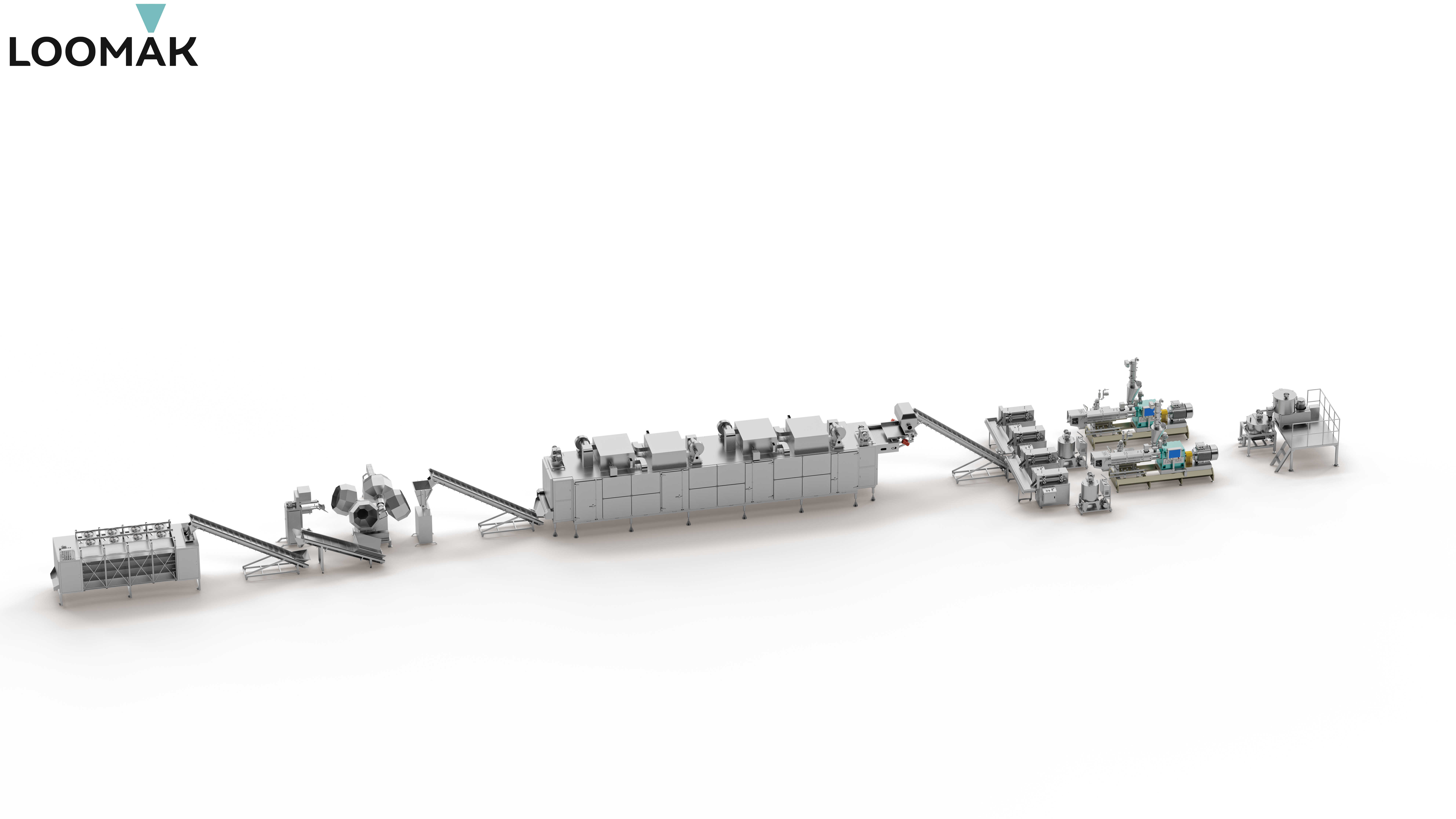
Extrusion Technology Dictates Versatility: Twin-screw extruders offer superior thermal dynamics and ingredient flexibility compared to single-screw systems, making them essential for complex, co-extruded, or core-filled snack profiles.
Modularity Enables Scalability: Selecting a production line with modular components allows manufacturers to seamlessly integrate specialized coating, flavoring, or co-extrusion mechanisms as market demands evolve.
Compliance and Automation are Non-Negotiable: Modern lines must feature sanitary, food-grade stainless steel construction (CIP-ready) and centralized PLC controls to minimize operator error and ensure strict food safety compliance.
Table of Contents
The foundation of any successful extrusion process begins with precise raw material preparation. Automated ingredient selection and hydration systems ensure that base flours are accurately measured and blended. You must handle cornmeal, rice flour, and wheat flour with exact precision. Uniform moisture distribution prevents extrusion blockages and ensures consistent expansion. Formulation variables directly influence the raw rheology before the mixture enters the extruder. The ratios of cornmeal to water and oil must remain stable. Inconsistent hydration leads to surging within the extruder barrel. This surging results in irregular snack shapes and unacceptable texture variations that ruin product batches.
Operators must monitor the mixing phase closely. High-speed ribbon blenders or continuous mixers are typically deployed to achieve a homogeneous blend. The moisture content usually targets between 14% and 20%, depending on the specific snack profile. If the moisture is too low, the mechanical shear inside the extruder generates excessive heat, leading to product scorching. If the moisture is too high, the dough lacks the necessary viscosity to expand properly at the die exit. We recommend installing inline moisture sensors to provide real-time feedback to the PLC, allowing for automatic water dosing adjustments.
The extruder serves as the core engine of the production line. It applies mechanical shear, high pressure, and controlled thermal dynamics to cook the raw ingredients into a viscous dough. As this dough is forced through the die head, the sudden drop in pressure causes the superheated moisture to flash off instantly. This physical reaction creates the characteristic puffed texture. Die-head design is paramount for shape consistency. The physics of immediate expansion at the die exit require precise temperature control across multiple barrel zones. You must achieve the target expansion ratio without scorching the product.
Barrel temperatures typically range from 120°C to 180°C in the cooking zones. The screw profile determines the amount of mechanical energy transferred to the dough. Kneading blocks and reverse pitch elements increase shear and mixing, while conveying elements move the material forward. Operators must balance screw speed, feed rate, and temperature to maintain a stable melt pressure behind the die. Fluctuations in melt pressure indicate unstable extrusion conditions and will immediately impact product quality.
Once extruded, the product must be accurately cut and shaped. Rotary cutting systems are mounted directly on the die face for high-speed, short-cut snacks. Vertical cutting systems offer clean edges and consistent length control for longer products. For core-filled snacks, the integration of core-filling pumps is necessary. These pumps inject creams, pastes, or chocolate simultaneously during extrusion through specialized co-extrusion dies. Post-extrusion forming options allow for the production of complex 3D or hollow snack shapes. Stamping and embossing equipment add significant versatility to the line.
Install the correct die plate for the desired product shape.
Align the rotary cutter blades flush against the die face to ensure clean cuts.
Calibrate the core-filling pump to match the extrusion speed exactly.
Adjust the cutter speed to control the final length of the snack.
Monitor the die pressure to prevent blockages in the co-extrusion tubes.
After extrusion, the snacks retain excess moisture that must be removed to achieve the target crunch and ensure shelf stability. Continuous multi-pass belt dryers are highly favored over batch systems. They provide superior energy efficiency and optimal space utilization. Evaluating the thermal efficiency and moisture-removal rates is essential to reach the desired water activity. Proper drying prevents microbial growth and prepares the snack surface for subsequent oil and flavor application. The target moisture content after drying is typically between 1.5% and 3%.
Dryer airflow must be carefully balanced. Updraft and downdraft zones ensure even moisture removal across the entire product bed. If the airflow is uneven, some snacks will remain soft while others become overly hard. Temperature zones within the dryer usually start high to rapidly remove surface moisture, then decrease to gently dry the center of the snack without causing case hardening. Regular cleaning of the dryer belts is required to prevent product buildup and maintain optimal airflow.
The final processing stage involves flavoring and cooling. Rotary seasoning drums ensure uniform distribution of oil and powder flavors while minimizing ingredient waste. Electrostatic coating technologies improve powder adhesion significantly. Slurry preparation systems are utilized for applying cheese coatings or sweet glazes. They rely on high-accuracy liquid spray nozzles for even coverage. Following the flavoring stage, ambient cooling conveyors are mandatory. Cooling the snacks before packaging prevents condensation within the bags. Condensation leads to premature spoilage and loss of crispness.
The flavoring drum must be pitched at the correct angle to control the product retention time. If the snacks pass through too quickly, the coating will be uneven. If they stay too long, they may break apart. The spray nozzles must be calibrated to deliver the exact percentage of oil or slurry required by the recipe. Frequent nozzle inspections are necessary to prevent clogs that disrupt the coating process.
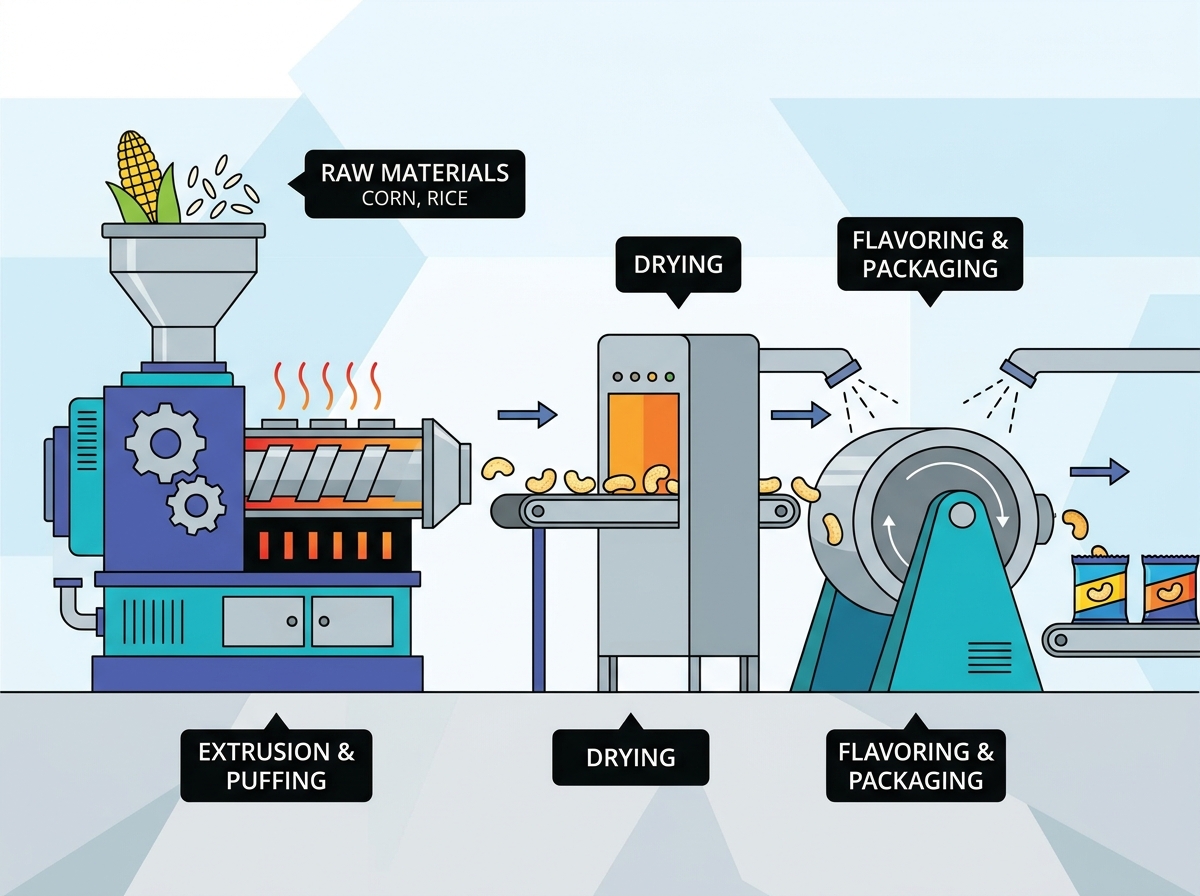
Single-screw extruders rely heavily on the specific friction generated by the raw materials against the barrel walls to create the necessary cooking heat and pressure. This reliance limits their application. They struggle to process recipes with high moisture, high fat, or high sugar content. These ingredients act as lubricants, reducing friction and preventing adequate cooking and expansion. Single-screw systems are generally sufficient only for basic, direct expanded corn curls where formulation variables remain strictly controlled and consistent.
When operating a single-screw machine, you must maintain strict control over the raw material particle size. Variations in cornmeal granulation will drastically alter the friction profile inside the barrel. This leads to surging and inconsistent product expansion. Single-screw machines also lack the self-wiping capability, meaning they require more frequent teardowns for manual cleaning, especially when changing recipes.
Twin-screw extruders utilize two intermeshing screws rotating within a figure-eight shaped barrel. This design provides a positive displacement pumping action. It ensures consistent material flow regardless of the recipe's frictional properties. The self-wiping mechanism of the intermeshing screws prevents material buildup and burning. Twin-screw systems offer precise control over shear, residence time, and temperature profiles across multiple zones. They handle diverse grain blends, including rice, quinoa, and chickpea. They process complex formulations with a significantly lower risk of material surging or blockages.
Feature | Single-Screw Extruder | Twin-Screw Extruder |
|---|---|---|
Material Flow | Friction-dependent | Positive displacement |
Ingredient Flexibility | Low (basic grains only) | High (handles high fat/sugar) |
Self-Cleaning | No | Yes (intermeshing screws) |
Shear Control | Limited | Precise (modular screw profiles) |
Maintenance Frequency | High (frequent teardowns) | Lower (self-wiping reduces buildup) |
Matching machine output to current sales volume and projected growth is a critical early step. Facility managers must evaluate the machine's capacity in kilograms per hour against their operational schedules. Deciding whether to run multiple shifts on a smaller line or invest upfront in a higher-capacity puffed snack production line requires careful analysis of facility capabilities and labor availability. Scalability also depends on the modularity of the equipment. Modular designs allow for future upgrades without replacing the entire system.
When calculating throughput, you must account for operational downtime. A machine rated for 500 kg/hr will not produce 12,000 kg in a 24-hour period. You must factor in time for cleaning, recipe changeovers, and preventative maintenance. We recommend sizing the equipment to meet your 3-year production targets while running at 80% capacity. This provides a buffer for unexpected demand spikes and reduces wear on the machinery.
Modern production lines rely heavily on centralized PLC and HMI touchscreens for recipe management and automated start/stop sequences. These controls eliminate operator guesswork and ensure batch-to-batch consistency. Advanced IoT sensors provide real-time die-pressure monitoring. AI-powered thermal adjustments automatically compensate for minor fluctuations in raw material moisture. Continuous motor load and vibration monitoring enable predictive maintenance alerts. Technicians can address mechanical wear before it causes catastrophic downtime.
The HMI should display a comprehensive overview of the entire line. Operators need immediate access to barrel temperatures, screw speeds, cutter speeds, and dryer temperatures. Recipe management systems allow you to save specific parameters for each SKU. When switching from corn puffs to rice rings, the operator simply selects the new recipe, and the PLC automatically adjusts the setpoints. This drastically reduces changeover time and minimizes out-of-spec product during startup.
The physical layout of the factory dictates whether a linear or U-shaped line configuration is most appropriate. Beyond floor space, utility requirements are substantial. A standard line requires robust three-phase power infrastructure. You need high-volume natural gas or steam for the drying modules. Compressed air is required for pneumatic controls. Extensive exhaust ventilation is mandatory for dryers and fryers. Failing to audit facility utilities prior to equipment delivery often results in severe installation delays.
You must ensure adequate clearance around all equipment for maintenance access. Extruder barrels require space for screw removal. Dryers need clearance for belt inspection and cleaning. Do not cram the equipment into a tight space. Poor layout leads to sanitation failures and increases the risk of workplace injuries. Map out the utility drops carefully to minimize long runs of piping and electrical conduit.
Food safety compliance is non-negotiable. All product contact parts must be constructed from 304 or 316L stainless steel. You must utilize sanitary welding techniques that eliminate crevices where bacteria can harbor. The equipment must be evaluated for ease of cleaning. Accessible internal components and clear washdown protocols are essential. Ensuring the machinery complies with CE, ISO, HACCP, and FDA standards is mandatory for passing regulatory inspections and maintaining consumer safety.
Look for equipment with sloped surfaces that prevent water pooling. Motors and gearboxes should be fully enclosed or shielded to withstand high-pressure washdowns. Conveyor belts must be easily removable for deep cleaning. Establish strict swabbing protocols to verify sanitation effectiveness. Any dead legs in the piping or hard-to-reach areas in the dryer will eventually harbor pathogens, leading to costly product recalls.
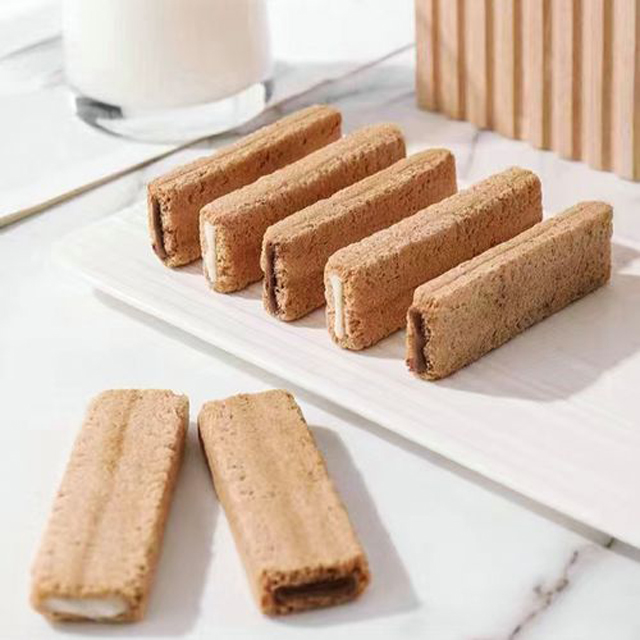
Producing direct expanded snacks requires high-shear extrusion profiles. The system must generate a rapid pressure drop at the die face to facilitate immediate moisture flash-off. This process relies on specific screw configurations that maximize mechanical energy input. It creates a highly expanded, airy texture characteristic of traditional cheese puffs and corn curls. The raw material formulation must be tightly controlled to ensure consistent expansion.
The die plate design is critical for direct expanded products. The land length of the die hole determines the back pressure and the final shape of the snack. A shorter land length results in more expansion, while a longer land length produces a denser product. Operators must monitor the die face closely. Any buildup of burnt material will distort the snack shape and require immediate cleaning.
Adapting the line for core-filled snacks introduces significant technical complexity. Co-extrusion dies must be precisely machined to guide the outer cereal shell around the injected filling. Synchronized filling pumps are critical. They must match the extrusion speed perfectly to prevent leakage, hollow centers, or uneven shell thickness. The rheology of the filling must be carefully controlled. It must flow smoothly through the injection tubes without breaking down under heat.
The filling material is typically a fat-based cream or paste. Water-based fillings will migrate into the cereal shell, causing the snack to become soggy and reducing shelf life. The temperature of the filling must be maintained precisely in the holding tank and the jacketed piping. If the filling is too cold, it will not pump evenly. If it is too hot, the fats may separate, ruining the texture and flavor of the final product.
Manufacturers must choose between installing a continuous frying module or a multi-pass convection dryer. Frying produces a snack with higher fat content and a distinct, rich texture. It requires rigorous oil management systems and extensive ventilation. Baking via a convection dryer yields a healthier nutritional profile and simplifies maintenance routines. The choice dictates the downstream flavoring equipment required. Baked snacks typically need a separate oil spray application to ensure dry seasonings adhere properly.
If you choose frying, you must manage free fatty acids (FFA) in the oil. Continuous filtration systems are required to remove carbonized particles. The oil turnover rate must be calculated to ensure fresh oil is constantly introduced, preventing rancidity. Frying systems also require robust fire suppression equipment due to the inherent risks of heating large volumes of cooking oil.
Thorough validation of the equipment prior to shipment is essential. Buyers must insist on comprehensive Factory Acceptance Testing (FAT) at the vendor's facility. You must utilize your exact raw materials and proprietary formulations during the FAT. This ensures the machinery performs to specification under real-world conditions. Following delivery, strict Site Acceptance Testing (SAT) parameters must be verified. This confirms post-installation calibration and operational readiness.
During the FAT, run the equipment at maximum rated capacity for at least four hours. Monitor motor loads, barrel temperatures, and product quality continuously. Do not accept the equipment if it fails to meet the agreed-upon specifications. Document all test results and require the vendor to address any deficiencies before authorizing shipment. The SAT should replicate the FAT conditions in your facility, ensuring that utility connections and environmental factors do not negatively impact performance.
Operational efficiency relies heavily on the speed of product changeovers. Evaluating the availability of quick-release extruder barrels and slide-out die plate configurations is necessary. This minimizes downtime when switching shapes. The coating system must be assessed for its ability to transition from sweet to savory flavors rapidly. You must avoid cross-contamination. This often requires modular seasoning drums or advanced Clean-in-Place capabilities.
Time your maintenance team during a simulated changeover. If it takes more than two hours to switch from one SKU to another, the equipment design is flawed. Look for tool-less adjustments wherever possible. Quick-disconnect fittings on piping and easily removable conveyor belts significantly reduce changeover times. Standardize your tooling to minimize the number of unique parts required for different products.
Complex twin-screw extruders require specialized technical knowledge to operate, troubleshoot, and maintain effectively. The primary risk is operator error leading to excessive waste or machine damage. To mitigate this, manufacturers must mandate comprehensive vendor training programs during the commissioning phase. Developing rigid standard operating procedures for startup, steady-state operation, and shutdown ensures that all shifts operate the machinery consistently.
Do not rely on verbal instructions. Create detailed, visual SOPs and mount them directly on the equipment. Train operators to recognize the early warning signs of process instability, such as fluctuating motor loads or inconsistent product shapes. Empower them to stop the line and correct the issue before generating large volumes of waste. Regular refresher training is essential to maintain high operational standards.
Prolonged downtime due to worn extrusion screws, scored barrels, or broken die plates can severely impact production targets. Establishing aggressive preventative maintenance protocols is critical. Maintenance teams must monitor screw wear indicators regularly. Securing service level agreements for rapid spare parts delivery ensures that critical components are readily available. This minimizes the impact of unexpected mechanical failures.
Keep a comprehensive inventory of critical spare parts on-site. This includes heating bands, thermocouples, die plates, and cutter blades. Do not wait for a component to fail before ordering a replacement. Measure the wear on the extruder screws during every major sanitation cycle. Once the flight clearance exceeds the manufacturer's tolerance, replace the elements immediately to maintain extrusion efficiency and product quality.
Flavor carryover and allergen contamination present severe safety and regulatory risks during production changeovers. Implementing strict Clean-in-Place procedures is mandatory. Utilizing modular seasoning systems where dedicated drums are used for specific allergen profiles can drastically reduce risk. Clear wet and dry cleaning protocols must be established and verified through swabbing and testing before a new production run commences.
Color-code your cleaning tools to prevent cross-contamination between raw and finished product areas. When running allergen-containing products, schedule them at the end of the production week to allow for a full teardown and deep clean over the weekend. Document all cleaning activities and maintain strict records to demonstrate compliance during regulatory audits.
Conduct a comprehensive facility audit to verify that existing electrical, gas, and ventilation utilities can support the new equipment.
Request pilot testing with your specific raw materials from shortlisted vendors to validate extrusion performance and product quality.
Review all warranty documentation, service level agreements, and spare parts availability before finalizing any procurement contracts.
Develop detailed standard operating procedures and mandate vendor-led training for all operators and maintenance personnel.
Choosing a puffed snack production line is more than purchasing individual machines—it requires careful coordination between product recipes, processing technology, factory utilities, automation, sanitation, and future production goals. LOOMAK specializes in twin-screw extrusion equipment and customized food deep-processing production lines, helping manufacturers combine processing requirements, equipment configuration, and production control into a more practical and scalable solution.FAQ
A: A standard linear configuration typically requires between 15 to 25 meters in length and 3 to 5 meters in width. U-shaped configurations can condense the linear footprint but require wider floor space. Adequate clearance around all modules is necessary for maintenance and sanitation access.
A: The extrusion and forming stages are identical, but the moisture control stage differs. A line can be designed with a diverter conveyor to send extruded products either to a continuous fryer or a multi-pass dryer, allowing for both variations within the same facility.
A: Direct expanded snacks rely on immediate moisture flash-off at the die face to create a uniform, airy texture. Core-filled snacks use a specialized co-extrusion die and a synchronized pump to inject a separate cream or paste into the center of the cereal shell as it expands.
A: Installation and commissioning typically take between two to four weeks, assuming all facility utilities are pre-installed and ready. This timeframe includes mechanical assembly, electrical integration, PLC programming, and initial product testing.
A: The equipment requires robust three-phase electrical power for the extruder motors, high-volume natural gas or steam for the drying and frying modules, compressed air for pneumatic valves, and extensive exhaust systems to manage heat and moisture.
A: Smart automation utilizes centralized PLCs and IoT sensors to monitor real-time variables like die pressure and barrel temperature. AI algorithms can automatically adjust thermal inputs to compensate for raw material inconsistencies, reducing product variance and minimizing operator intervention.


