Views: 0 Author: Site Editor Publish Time: 2026-08-05 Origin: Site
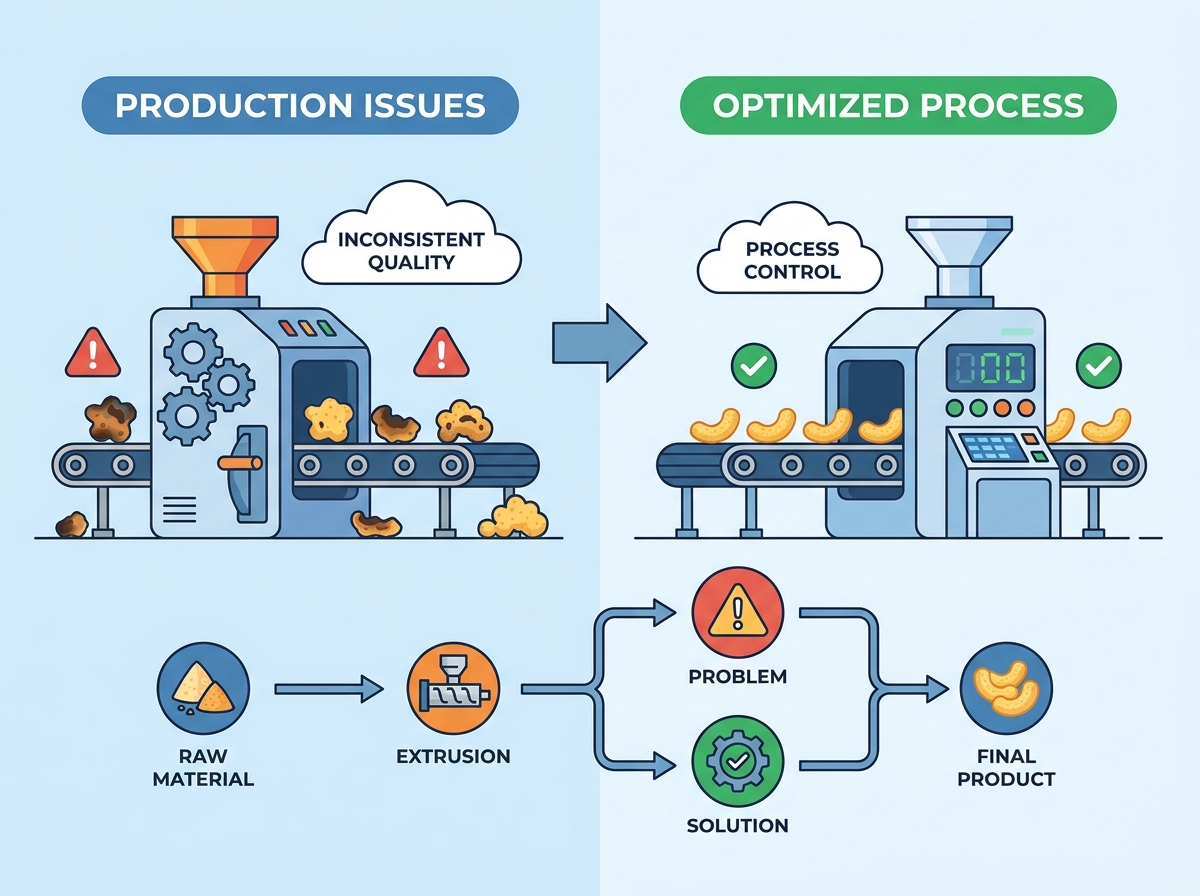
Commercial snack extrusion lines face severe financial hits from yield loss, unplanned downtime, and high defect rates. Minor fluctuations in moisture, temperature, or mechanical shear compound rapidly into massive product inconsistencies. You will see these variations manifest as structural collapse, excessive oil retention, or severe shape distortion right at the die face. Operators cannot rely on reactive, on-the-fly fixes to maintain profitability and product quality when dealing with complex starch matrices.
Resolving puffed snack production problems requires moving beyond temporary adjustments. It demands a systematic evaluation of raw material inputs, extruder configurations, and downstream processing capabilities. By understanding the thermodynamic and mechanical forces at play inside the barrel, plant managers can stabilize their output, reduce waste, and ensure a consistent consumer experience across every batch.
Most textural and expansion failures stem from improper moisture control and its effect on the starch glass transition phase during extrusion.
Inconsistent blending of grains and starches pre-extrusion acts as a primary catalyst for downstream structural failures and surging at the die.
Surface defects, such as greasiness or burning, are typically symptoms of die pressure imbalances, formulation constraints, or incorrect temperature profiling in the barrel zones.
Evaluating equipment upgrades (e.g., transitioning from single to twin-screw extruders) should be based on formulation complexity and required tolerance for raw material variance.
Implementing automated monitoring for die pressure and moisture content significantly reduces batch-to-batch variability and operator-dependent errors.
A high-yield, optimized puffed snack line must meet strict success criteria. The final product requires consistent bulk density, uniform cell structure, precise shape retention, minimal waste, and optimal throughput. Achieving these metrics depends entirely on controlling the physical and chemical transformations occurring inside the extruder barrel. When operators fail to monitor these parameters, the entire line suffers from cascading failures.
The mechanics of puffing expansion rely on rapid thermodynamic shifts. Inside the extruder, raw materials are subjected to high heat, pressure, and mechanical shear. This creates a viscous, superheated melt. As this melt exits the die, it experiences a sudden pressure drop. The superheated moisture flashes off into steam instantly. This action expands the starch matrix into a porous, crispy structure before it cools and solidifies. If the melt temperature is too low, or the pressure drop is insufficient, the expansion fails.
Identifying the root causes of production failures requires categorizing them into four distinct areas. We break these down to isolate the exact point of failure on the factory floor:
Pre-extrusion blending and raw material variance. This includes mixing grain and starch ratios, particle size distribution, and initial moisture content.
Mechanical and extrusion parameters. This covers screw shear, barrel temperature profiles, die pressure, and feed rates.
Downstream thermal processing. This involves the specific thermodynamic requirements of baking, frying, drying, or seasoning application.
Packaging-line mechanics and post-process environmental factors. This includes drop heights, conveyor vibration, and ambient humidity control.
Operators often observe fluctuating expansion rates and inconsistent bulk densities within the exact same production batch. Frequent extruder surging is another clear indicator of upstream feed issues. These symptoms point directly to inconsistencies in the raw material feed. If the feed is wrong, no amount of barrel adjustment will save the product.
Inadequate hydration during pre-conditioning prevents uniform starch gelatinization. Poor homogeneity in grain and starch blending causes the extruder to process varying formulations minute by minute. Raw ingredient separation inside the feed hopper exacerbates this. Heavy particles settle, while lighter starches float. This inconsistency directly impacts the melt viscosity, causing the extruder motor load to spike and drop erratically.
Establish standardized mixing times for all dry ingredients. Calibrate feed screw dosing systems daily to ensure accurate volumetric or gravimetric feeding. Enforce strict particle-size specifications for raw grain flours and starches. Varying particle sizes hydrate at different rates and separate easily during transport. Use a sieve analysis on every incoming batch of raw material to verify compliance.

When a product exits the die dense, hard, or glassy rather than light and crispy, the expansion framework has failed. The starch matrix did not trap the expanding steam effectively, or the steam lacked the energy to stretch the matrix. You will often see this when running high-protein or high-fiber formulations without adjusting the mechanical energy input.
Insufficient mechanical shear prevents the starch granules from fully breaking down. Low starch gelatinization levels mean the dough lacks the elasticity required to stretch during moisture flash-off. Inadequate barrel temperatures fail to superheat the water sufficiently to create the necessary vapor pressure at the die. If the water does not flash to steam aggressively, the product remains a dense pellet.
Adjust the screw speed to increase mechanical energy input. Modify the screw profile by adding kneading blocks or reverse pitch elements to generate higher shear. Altering the amylose to amylopectin ratio in the raw dough can also improve elasticity. Higher amylopectin levels generally yield better expansion. Monitor the specific mechanical energy (SME) readout on the control panel to ensure consistent energy transfer to the melt.
Too little water in the formulation leads to premature burning and severely restricted puffing. Conversely, too much water causes the expanded structure to collapse post-extrusion before the matrix can set. Moisture control is the single most critical variable in direct expansion extrusion.
The concept of glass transition temperature is critical here. Moisture acts as a plasticizer for starches, lowering the temperature required for the material to transition from a hard, glassy state to a pliable, rubbery melt. When water levels are too low, the melt temperature spikes rapidly before the glass transition is fully reached. This leads to internal scorching, high friction, and expansion failure. The product will look dark and have a burnt flavor.
Implement precise pre-conditioning of raw materials to ensure uniform hydration before the mixture enters the barrel. Install real-time moisture monitoring sensors at the feed zone and die exit. Track water levels dynamically and adjust water injection pumps instantly. Target a specific moisture percentage for the raw mix, usually between 14% and 18% for standard corn-based snacks, and hold it within a 0.5% tolerance.
Surging at the die, inconsistent product lengths, and variable expansion rates indicate an unstable pressure gradient inside the final barrel zones. The extruder should operate with a steady, continuous flow. When the product pulses out of the die, the internal pressure is failing.
Worn screw flights reduce the pumping efficiency of the extruder. This causes material to slip backward and pressure to drop. Partially blocked die holes create uneven flow velocities across the die face. Inconsistent feed rates starve the screws, causing pressure spikes and drops. A worn barrel liner will also allow material to bypass the screw flights, destroying the pressure profile.
Recommend strict maintenance schedules for die inspection and cleaning. Perform regular screw wear evaluations using bore gauges. Replace screw elements when wear exceeds the manufacturer's specified tolerances. Integrate closed-loop pressure control systems that automatically adjust screw speed or feed rate to maintain a constant die pressure.
Symptom Observed at Die | Probable Root Cause | Immediate Operator Action |
|---|---|---|
Dense, hard texture, glassy appearance | Low shear / Low barrel temperature | Increase screw RPM, check barrel heating zones for failed elements |
Extruder surging, pulsing flow | Inconsistent feed / Moisture variance | Verify feeder calibration, check pre-conditioner water flow meter |
Product collapse after puffing | Excessive moisture in melt | Reduce water injection rate, increase die temperature slightly |
Dark spots / Burnt smell | Low moisture / High mechanical friction | Increase water input, inspect screw wear, lower RPM |
Uneven product lengths | Blocked die holes / Cutter speed mismatch | Clean die face, adjust rotary cutter speed to match extrusion rate |
Certain extruded snacks absorb excessive oil during downstream frying or seasoning. This escalates production costs and degrades shelf life by accelerating rancidity. A greasy product leaves residue on the packaging and ruins the consumer experience. This is a common issue when switching from traditional corn grits to alternative bases.
High oil absorption is directly connected to an overly porous internal cell structure. Excessive moisture retention prior to the fryer causes water to boil out violently. This leaves large voids that oil quickly fills. Alternative starches, such as potato, banana, or high-sugar root flours, process differently than corn or wheat. They naturally demand different frying profiles and often create thinner cell walls that soak up fat.
Adjust the drying phase time and temperature to create a proper surface crust before oil application. This crust acts as a barrier. Optimize fryer dwell times based on the specific formulation starch type. Utilize rapid, high-heat frying for highly porous structures to minimize oil soak time. Ensure the oil turnover rate in the fryer is high enough to prevent free fatty acid buildup.
Dark spots, burnt off-flavors, and excessive die build-up ruin product aesthetics and taste profiles. When running formulations with high sugar content, operators must monitor the final barrel zones constantly. Sugar burns quickly under high shear.
The Maillard reaction and sugar caramelization accelerate rapidly in high-heat extrusion zones. Formulations high in reducing sugars are particularly vulnerable. When melt temperatures spike due to low moisture or high shear, these sugars burn against the barrel walls and die face. This creates hard carbon deposits that eventually break off into the product stream.
Lower barrel temperatures in the final zones just before the die. Increase moisture slightly to cool the melt through evaporation and reduce mechanical friction. Reformulate with heat-stable ingredients if possible. Inject sensitive flavorings and sugars downstream in the coating drum rather than mixing them into the raw extruder feed.
Products that puff initially at the die but shrink, shrivel, or become chewy after cooling suffer from structural collapse. The product looks great at the cutter but turns into a dense, unappealing mass by the time it reaches the packaging room.
This indicates a weak expansion framework. Poor starch and dough binding, low protein integration, or inadequate post-extrusion drying fail to lock the expanded matrix in place. If the moisture is not removed quickly enough, the starch remains plastic and collapses under its own weight. High ambient humidity in the plant can also cause rapid moisture reabsorption before the product is sealed.
Evaluate the efficiency of the drying oven or belt. Recommend specific time, temperature, and humidity profiles to stabilize the starch matrix rapidly. Ensure adequate airflow through the product bed to remove evaporated moisture. Check the exhaust fans on the dryer to confirm they are pulling the humid air out of the chamber effectively.
Ragged edges, tailing, or snacks sticking together on the conveyor indicate cutting failures at the die face. A clean cut is essential for product appearance and consistent bulk density. If the product smears across the die, the cutter setup is wrong.
Incorrect cutter speed relative to extrusion velocity causes uneven lengths. Dull blades tear the product rather than slicing it cleanly. A melt viscosity that is too sticky at the die face causes the product to adhere to the blade. This stickiness is often caused by poor starch and water binding or an incorrect screw profile that fails to cook the starch fully.
Evaluate cutter configurations based on the product. Direct face cutters work well for dense products. Off-set cutters prevent smearing on highly expanded items. Adjust the melt temperature to control surface stickiness. Replace cutter blades at the start of every shift and ensure the blade tension against the die face is calibrated correctly.
Uneven color development, moisture pockets causing soft centers, or rapid rancidity point to thermal processing failures. The extruder only does half the work. The downstream thermal equipment must finish the moisture removal process accurately.
Baking relies on hot air convective drying. This removes moisture slowly from the outside in. Frying uses oil conductive immersion. This drives moisture out rapidly while replacing it with fat. Mismanaging either process traps moisture internally. If a baked product is heated too quickly, the outside hardens while the inside remains wet.
Establish strict moisture target zones post-extruder. Calibrate drying curves to prevent case hardening. This is a condition where the exterior dries too quickly, sealing the surface and trapping water inside the snack core. Use a multi-zone dryer to step down the moisture gradually, starting with high heat and moving to lower heat with high airflow.
Process Type | Heat Transfer Method | Common Defect | Corrective Action |
|---|---|---|---|
Baking / Drying | Convective (Hot Air) | Case hardening (wet center) | Reduce initial zone temperature, increase airflow |
Frying | Conductive (Hot Oil) | Excessive oil absorption | Increase pre-fry drying time, raise oil temperature |
Baking / Drying | Convective (Hot Air) | Uneven moisture across belt | Adjust product bed depth, clean air distribution plenums |
Frying | Conductive (Hot Oil) | Rapid oil degradation | Increase oil turnover rate, filter fines continuously |
Uneven flavor distribution, seasoning fall-off in the bag, or clumping in the coating drum lead to consumer complaints and wasted ingredients. Seasoning is often the most expensive component of the snack. Wasting it on the bottom of the bag destroys profit margins.
Poor adhesion links directly to incorrect base snack temperatures. If the snack is too cold, oil and powder will not bind. Improper oil spray rates create dry spots or overly wet clumps. Suboptimal drum flighting fails to tumble the product effectively, causing the snacks to slide rather than roll through the seasoning mist.
Implement electrostatic seasoning application for dry powders to ensure uniform coverage. Utilize two-stage slurry coating systems for complex flavor profiles. Apply a liquid tack coat followed by the dry seasoning. Maintain the base snack temperature between 40°C and 50°C as it enters the drum to promote optimal oil absorption and powder adhesion.
High product breakage rates during bag-filling, crushed snacks, or loss of crispiness within weeks of packaging destroy the final product value. You can run a perfect extrusion process, but if the packaging line shatters the product, the batch is ruined.
High drop heights on packaging scales shatter fragile internal cell walls. Poor expansion structure makes the product inherently weak. Inadequate barrier film selection allows ambient moisture to transfer into the bag, destroying the crisp texture. Oxygen ingress leads to rapid rancidity of the surface oils.
Introduce gentle product handling mechanisms. Use vibrating conveyors instead of bucket elevators where possible. Reduce drop heights across the packaging line scales. Optimize cell wall thickness at the extruder for better structural integrity. Audit packaging film oxygen and moisture transmission rates to ensure they match the product's shelf-life requirements.
Addressing persistent production issues sometimes requires evaluating the core machinery. Transitioning from a single-screw to a twin-screw extruder provides superior mixing, better shear control, and the ability to handle complex formulations with higher moisture or fat contents. Twin-screw systems offer positive displacement, meaning they pump material forward regardless of viscosity changes. Upgrades should be justified by the formulation complexity and the required tolerance for raw material variance. Automated control systems for water injection and thermal regulation offer immediate returns by reducing operator error and stabilizing the extrusion process.
Implement daily calibration checks for all volumetric and gravimetric raw material feeders to ensure consistent formulation delivery.
Install real-time moisture sensors at the pre-conditioner and die exit to maintain strict control over the starch glass transition phase.
Establish a routine inspection schedule for extruder screws and die plates to identify wear before it causes pressure drops and surging.
Adjust downstream drying and frying profiles specifically to the starch type being processed to prevent excessive oil absorption and structural collapse.
As a national high-tech enterprise based in Jinan, Loomak integrates food-processing machinery research, manufacturing, sales, and process support, with twin-screw extrusion and puffing equipment at the center of its business. Its customized production-line planning combines processing technology, equipment configuration, and control systems to help food manufacturers achieve more stable quality, efficient output, and lower production losses.
A: Dense snacks result from inadequate moisture flash-off at the die. This is typically caused by low mechanical shear, insufficient barrel temperatures, or poor starch gelatinization during pre-conditioning. Operators must increase screw RPM or adjust barrel heating to ensure the water superheats properly.
A: Reduce the porosity of the internal cell structure by adjusting the extruder shear. Ensure the snacks are adequately dried to form a surface crust before they enter the fryer. This crust limits oil penetration during the frying process.
A: Surging indicates inconsistent pressure at the die. This is usually caused by irregular raw material feeding, fluctuating moisture levels in the pre-conditioner, or worn screw flights failing to convey material evenly. Check feeder calibration and inspect screws for wear.
A: It is the specific temperature at which starches change from a hard, glassy state to a pliable melt. Moisture acts as a plasticizer, lowering this temperature and allowing the starch to expand properly at the die without burning.
A: Structural collapse happens when the expanded starch matrix is too weak to hold its shape. This is often due to excessive moisture in the formulation or inadequate post-extrusion drying failing to set the structure before it cools.
A: Ensure the base snack is at the correct temperature when entering the coating drum. Optimize the oil spray rate to create a tacky surface. Consider using electrostatic application for dry powders to improve adhesion and reduce waste.


